Saturday, January 30, 2010

finally, a dessert recipe: clafoutis

In the minimalistic spirit of many other recipes on this blog, I bring you clafoutis - easily one of my favorite desserts of all time (and the first dessert recipe on HOUSEKEPT). There are only about five ingredients, all of which you should have on hand, so make it this weekend. I had the distinct pleasure of eating copious amounts of this pudding-like dish while studying in Pau, France. My host mother was from Limousin, a rustic region of France known for cherries, porcelain, and beef. At the time I was completely unaware of this wondrous dessert; that is, until my host mother prepared two of these in late spring when cherries are in season. Essentially a baked custard-like cake, clafoutis tastes a lot like a very thick crepe mixed with fresh cherries.

Clafoutis embodies what a rustic, homemade dessert should be - the effortless combination of a few pantry staples (sugar, eggs, and flour) and ripe, seasonal fruit. Because you mix the fruit into the batter, almost any fruit will work well. Countless cookbooks contain variations on the classic cherry version, but the most common other fruits would be berries, stone fruit (peaches, nectarines), or pears. The traditional recipe calls for kirsch, a cherry-based spirit, but you could also use cognac, armagnac, bourbon, or some other digestif-type booze. Now for the recipe...

After making clafoutis from quite a few different recipes, I think Anthony Bourdain came the closest to what I ate in France (though I really should ask my host mother) in Les Halles, his manifesto of a cookbook. As a stickler, he uses weight instead of volume for the dry ingredients, but you should be able to convert these quite easily. I made it with pears recently, but the same recipe works well for a number of different fruits.


Ingredients
  • 1.5 lbs cherries or other fruit
  • 3 ounces booze (kirsch, cognac, etc.)
  • 1 tbsp butter
  • 4 oz sugar
  • 6 eggs
  • 4 oz flour
  • 1 tsp vanilla extract
  • 1 tbsp confectioners' sugar
Technique
  1. Place the cherries in a bowl and toss with the kirsch. Let macerate for 1 hour.
  2. Preheat the oven to 450 degrees F. Grease a 9-10 inch baking dish with the butter and coat with a pinch or two of the sugar. Place the dish in the refrigerator.
  3. In a large mixing bowl, beat the eggs with a whisk, then add the sugar and beat well to fully incorporate.
  4. Mix in the flour and the vanilla, stirring enough so that all the ingredients are homogenous but without overworking the flour.
  5. Using a rubber spatula, fold the cherries and their accumulated juice into the flour and egg mixture, then pull your dish out of the fridge and turn the mixture into it. Bake in the oven for about 40 minutes, or until a golden brown crust has formed on top. Also, a toothpick inserted into the center should come out clean - no wet.
  6. Dust with confectioners' sugar and serve warm or at room temperature.

Friday, January 22, 2010

recipe: winter herbless pesto

As you may have noticed, I haven't written nearly as much over the past few months, and the recipes I've published are quite spartan. This is because we had our second child, a boy, in October, and it's hard enough to cook something healthy, much less write about it. However, I am learning a lot about (and practicing) fast, wholesome, winter meals, such as the broiled eggs I wrote about earlier this month. Some people fall to convenience foods during such times, but I choose to strip down my cooking even more.

Yesterday I think I perfected what may be the perfect two-young-children-cold-winter-weeknight-that-you-could-still-serve-company meal: pasta with an herbless pesto sauce. One of the many challenges of cooking with small children is a sudden decrease in trips to the co-op. Combine that with a lack of fresh local produce, and one begins to find new romance in the pantry. After you make this one time you'll be able to make it blindfolded, without a recipe or planning.

Ingredients

  • 1 pound dried pasta (whole wheat spaghetti or penne taste great with this)
  • 1 large garlic clove
  • 1/4 lb parmesan or other hard cheese, plus more for grating
  • 1 heaping cup of walnuts, toasted
  • 1/2 cup olive oil
  • 1 tsp dried oregano
  • 1 tsp coarsely ground black pepper
  • pinch of sea salt
Techinique
  1. In the small bowl of a food processor, fitted w/ a blade attachment, combine garlic, cheese, walnuts, oregano, pepper, and salt. Pulse until the mixture resembles coarse breadcrumbs.
  2. Turn the food processor on and add olive oil until mixture resemles an oily paste (much like basil pesto).
  3. Cook pasta, drain, and toss briefly with the pesto sauce. Top individual plates with grated cheese.
*Serves 4 as a main dish or 6 as a first course.

Saturday, January 9, 2010

broil your eggs for a change

The word "broiled" isn't the finest or most elegant, but the eggs that result from this recipe surely are, with very little effort. This is a great recipe for house guests, or a leisurely brunch with your mate sans children (although, kids like these eggs, too). I found this recipe in Ina Garten's Barefoot in Paris cookbook, which I received as a gift from a good friend who also loves to eat. It's a very concise book that serves as a thoughtful introduction to French cooking, with an emphasis on simple, beautiful food, such as this dish.

As with most egg recipes, the key to this one is timing. The cooking times listed below work well for my oven and baking dish, but it will take you a few tries to perfect this recipe. The good news is that these eggs still taste good slightly overcooked, so don't worry if you miss the mark. It's also critical to use the best eggs you can find, since there isn't much else in the dish - 99 cent CostCo eggs will taste like 99 cents.

ingredients

  • 8 very fresh, large eggs (organic, free range if at all possible)
  • 1/2 garlic clove, minced with a knife (don't use a press, as it will taste too strong)
  • 1/2 cup finely (and freshly) grated super-hard cheese, such as Parmigiano-Reggiano
  • 1 tablespoon fresh herbs, minced (thyme, rosemary, basil, or parsley work well)
  • 2 tablespoons cold butter
  • 1/4 cup heavy cream
  • kosher salt and black pepper
  • 8 slices of crusty bread (toasted or warmed)
equipment
  • 4 small gratin dishes (just large enough to hold 2 eggs) or a ceramic/glass baking dish (large enough so that 8 eggs are about 1.5 inches deep).
*I use a baking dish because I don't have gratin dishes, so the process and timing described below may not work as well for several smaller dishes.

technique
  1. Preheat your oven using the broil setting (Note: my oven has a drawer-style broiler, below the main oven space. When I set it to broil the drawer and oven heat up, which is useful in this recipe.)
  2. Using a fork, mix the garlic, herbs, and cheese in a small bowl until well combined.
  3. Liberally grease the gratin dishes or baking dish with some of the butter. Pour in the cream so that it covers most of the bottom of the dish. Cut the remaining butter into small pieces and scatter these around the baking dish. Place the dish in the oven and heat until the cream begins to bubble and brown slightly around the edges, about 5 minutes. Remove from the oven and place on stove top.
  4. Carefully crack the eggs into the dish so that the yolks remain whole. Try to keep them evenly dispersed. Sprinkle them with salt, pepper, and the cheese/herb/garlic mixture.
  5. Place the dish in the oven and bake for about 5 minutes, or until the whites begin to set up but the yolks and tops of the eggs are still liquid.
  6. Move the dish into to the broiler drawer and cook 2-4 additional minutes, or until the top has browned slightly, the eggs are somewhat firm (it's good if the whites are a bit runny), and the yolks are still soft (some yolks may be softer than others - that's ok). This is the part of the recipe that takes the most practice, as it's really a visual judgment. Keep in mind that the eggs will continue to cook in the hot dish after you remove them from the broiler, so use a knife to see how thorough they're cooked and check them again after resting on the counter top for a few minutes.
  7. To serve, use a knife to cut eggs into sections and use a spatula to gently place them on plates with the bread on the side.
*Serves 4 people

Monday, January 4, 2010

holy f. i just read the ingredient list for Cool Whip.

Well, the planets aligned and somehow I ended up with a donated tub of Kraft (owned by Phillip Morris) Cool Whip in my fridge during the holidays. I ate this amorphous whipped topping more than I care to admit during my childhood, but I never really cared to look at the ingredient list. OMFG. Not only is it long and loaded with polysyllabic chemical compounds, but the ingredients fail to include the one substance that most quickly comes to mind. Can you guess which one?

WATER, CORN SYRUP, HYDROGENATED VEGETABLE OIL (COCONUT AND PALM KERNEL OILS), HIGH FRUCTOSE CORN SYRUP, LESS THAN 2% OF SODIUM CASEINATE (FROM MILK), NATURAL AND ARTIFICIAL FLAVOR, XANTHAN AND GUAR GUMS, POLYSORBATE 60, SORBITAN MONOSTEARATE, BETA CAROTENE (COLOR).


Cream! It seems you can have whipped cream without eating cream. Of course, they did manage to squeeze in some sodium caseinate, which is a milk-based derivative, but it seems Cool Whip exists without any naturally occurring ingredients (except water).

Mmmm... Sorbitan monostearate.

Tuesday, December 15, 2009

easy charcuterie: dry-cured duck breast

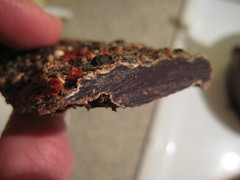
Do you like cured hams? I like cured hams. Prosciutto, Serrano, Bayonne. Salty, sweet, funky hams. Unfortunately for the home charcutier, a good aged ham requires about a 20 pound hog leg and at least six months of time - not to mention a climate controlled drying chamber. However, one can apply the same concept to a simple boneless duck breast, either wild or farm raised. Duck meat, especially the breast, has an exquisite earthy sweetness that shines after a good curing.

Several years ago I stumbled across a very simple cured duck breast recipe in Mario Batali's Babbo cookbook. Just pat it dry, roll it in salt and spices, and hang for about 10 days. I've been waiting for a surplus of duck to use for this recipe, but I only hunt waterfowl a few days per season, so I've never had more than one or two birds to eat. This year the waterfowl hunting gods blessed me with a very fast morning, so it seemed like a good time to cure some duck. The results were quite tasty.

I'm guessing wild goose would work equally well, perhaps even better given its larger size and thickness. In fact, Hank Shaw has a tantalizing recipe for this on his fantastic wild cookery blog.


Recipe: Dry-Cured Wild Duck Breast

Ingredients

  • 2 split wild duck breast (4 pieces)
  • 4 tablespoons kosher salt
  • 3 tablespoons freshly ground black pepper
  • 1 tablespoon sugar
  • 1 tablespoon hot red pepper flakes (use less if you can't handle heat)
  • 1 tablespoon chopped thyme leaves
Technique
  1. In a small bowl, combie the salt, pepper, sugar, red pepper flakes, and thyme. Coat the duck breast with this mixture, wrap it loosely in wax paper and refrigerate for 2-3 days.
  2. Unwrap, wipe off most of the seasoning. Punch a small hole on one end of the breast and tie a length of twine long enough to hang from your cool basement ceiling or refrigerator shelf.
  3. Hang the breast in a cool, dark, semi-humid place (an unfinished basement in winter works well) for 1-2 weeks, or until the breast shrinks to nearly half its original size and feels quite firm to the touch. When sliced, the breast should be wine colored and have a nice, hammy chew.
Serve the duck sliced very thin with cocktails on a salumi plate or as part of a creative first course - Mario Batali likes it with white beans.

Wednesday, November 18, 2009

woodcock: the other red meat.

Minnesota is a blessed place for a number of reasons, including an abundance of native wildfowl. Most people have heard of ruffed grouse, but what about Scolopax Minor, the noble woodcock? I recently heard a wonderful NPR interview with Clotilde Dusoulier, a young Parisian food blogger who translated Je Sais Cuisiner, an epic French cookbook, into English. I don't yet have this book but it has since risen to the top of my personal Christmas gift list. During the interview Clotilde describes how the book was intended to help a new bride cook simple, traditional French food for her new family. Among other interesting bits, she mentions that the author included recipes for some obscure dishes, some of which include wild game, because the polite cook must know what to do with a delicious wild boar or woodcock if an uncle happens to leave one at the house. You should be so lucky.

Woodcock is perhaps the most fleeting of Midwestern delicacies. Each fall, the mysterious upland birds migrate from the Northern US (mainly the Upper Midwest and New England) and Canada to the Southern states for the winter. Native Minnesota birds can be found throughout October, but large concentrations of migratory birds are only in the state for 2-3 weeks, depending on the weather, which adds to their allure as game. Their bodies are about the same size as a quail but they have a long neck, large black eyes, and a long pointed beak designed to dig in the soil for earthworms. With a taste that loosely resembles wild duck, Woodcock are truly glorious if roasted simply in a hot oven. To fully appreciate the mystique and obsession surrounding la bécasse, particularly in Europe, I recommend reading this web page. Not surprisingly, the French are the most rabid fan club, but Woodcock also are held in high esteem in the UK.

There are a few classic preparations for woodcock, most of which are mentioned in the Larousse Gastronomique. This is a variation on one of the most typical techniques.

Ingredients

  • 1 whole woodcock, plucked
  • 4 tablespoons of delicious butter, softened
  • coarse sea salt (French grey is very good for this)
  • coarsely ground black pepper
  • 1 tablespoon olive oil
  • 1/2 cup of equally scarce red wine
  • 6-8 baguette slices
Technique
  1. Preheat oven to 400 degrees. Smear the inside and outside of the bird with 2 tablespoons of the butter, making sure the breasts are well coated. Sprinkle generously with salt and pepper, again, inside and out.
  2. Heat the oil in a small heavy-bottomed sauce pot over medium heat. When it begins to smoke, add the bird and brown on all sides (about 5 minutes total).
  3. Transfer the pot to the oven and roast 10-15 minutes, or until the bird is golden brown, and the inside is hot to the touch. Important: Like duck, woodcock must be served rare or medium rare to retain its wonderful texture and flavor. The breast should be blood red when you slice it, but not cold (it's not sashimi).
  4. Put the bird on a cutting board to rest. Pour out all but one tablespoon of the fat in the pot and heat the pot over medium flame. Deglaze the pot with the wine, making sure to scrape everything tasty off the bottom. Let the wine reduce to a light, syrupy sauce. Then remove from heat, whisk in the butter, and check the seasoning.
  5. Pull the legs off of the bird and eat them while you finish the dish (with a fat glass of wine).
  6. Remove the breasts from the carcass and slice them thinly. Top the baguette slices with the sliced meat, drizzle with sauce, and sprinkle with a pinch of sea salt.
*This makes 6-8 canapés to share, or a small meal for one.

A dish this special deserves an equally special wine. The French recommend a big, bold, dry red wine. I don't argue with them. There is even a French vineyard, Domaine de la Mordorée (Chateauneuf-du-Pape), that celebrates the elusive woodcock on its bottle labels. I drank this with a woodcock I ate last year and I won't ever be the same.

Tuesday, September 22, 2009

grocery wars

I'd prefer to write about this epic struggle, but one can only dwell in fantasy for so long. The top business story in Sunday's St. Paul Pioneer Press, "Food Fight," details the present landscape of mainstream grocery stores in our oft named battleground state. Well written and detailed, the piece describes how grocery market share in MN has changed over the past few years, particularly in the Minneapolis/St. Paul metro area.

The overarching trend discussed in the article is clear: huge, extreme discount stores - mainly Walmart and Target - are attracting more and more shoppers away from Minnesota-based or regional chain stores, such as Kowalski's, Cub Foods, and Rainbow Foods. Many key issues are addressed, including unionization, loss-leaders, and extreme discounting (Walmart vs. Cub). Aside from the fact that co-ops and co-op-like stores aren't mentioned in the article, the most interesting part (for me) is the perspective offered by and about smaller grocery retailers, such as Kowalski's. Here's an excerpt:

The nine-store Kowalski's strategy is to hunker down, focus on quality and see when the economy improves, said Jim Kowalski. "We're not doing any growth right now," he said. "We don't pretend to compete in the price wars that seem to be going on."


Let's face it. There are at least as many types of grocery shoppers as there are brands of frozen pizza at Cub Foods (which was 27 last time I checked). Some people are loyal to one store, at which they buy everything. Others play hopscotch with several retailers, buying different items across multiple stores. Still others are perhaps a bit more schizophrenic, shopping at a different store depending on immediate geographic location (work, school, neighborhood) or emotional state (indulgent, frugal, or green). Such is the state of our food culture.

I am not a grocery store business expert or analyst, but I do buy a lot of food and attempt to follow these trends closely. To date, I have spent money at nearly every grocery retailer mentioned in the article, the exceptions being Aldi's/Trader Joe's and Walmart/Sam's Club. However, for the past 5 years or so, I've chosen to abandon corporate grocery stores in favor of co-ops, of which there aren't nearly enough. That's a different blog post altogether.

What if the challenge Kowalski's faces is an opportunity? A crowded market is dangerous for business as usual, so perhaps the time is right for some lasting innovation among smaller grocers. Jim Kowalski's quote acknowledges that his stores, despite their focus on "quality" (whatever that means), cedes a defeatist outlook by using expressions like "hunker down" and a lack of "growth." He claims to not "pretend to compete in the price wars," but his market share has decreased as a result of shoppers migrating to newer, bigger stores. He doesn't compete because he can't, at least not solely on the price of Brazilian orange juice concentrate, yet he would like to open additional stores.

Fundamentalist discount shoppers seek the lowest prices on food products, without much (or any) regard for the costs associated with producing, distributing, or selling those products, such as the energy (e.g. gasoline), environment (e.g. chemical pesticides), and community (e.g. wages). Smaller grocers should forget about these people. They live on a different planet or will have to soon.

Rather than use the same vocabulary and approach to growth (i.e. increasing profits, number of stores, and market share), smaller grocers should be and celebrate what the super stores are not: progressive, community-building organizations that sell healthy, fairly priced products (a lot of which are local) and create sustainable, livable jobs. If the tremendous growth of farmers' markets is any indication, there is an increasingly vocal segment of the grocery-buying public that seeks a different choice. Find them and sell them what they want. Co-ops have figured this out, so why can't the local supermarket? Such an outlook may squash a regional executive's dream of creating the next national chain store, but within a different framework, that executive no longer will be needed, and neither will the additional 5 stores he or she hoped to open. A small, efficient neighborhood store can hold a reasonable monopoly. Why must we always need more?

Here's an idea. Maybe the Kowalski's in Stillwater could sell meat, dairy, and produce from the St. Croix river valley, and the Grand Avenue store could sell products from Gardens of Eagan. Add a kick-ass bulk section and show people how to use it. If you can't compete on the price of Tyson chicken fries, then sell real chickens from Callister Farm. Think differently. Yes, these products cost more, but an educated customer understands and appreciates the quality of such products. If I want to find the lowest price on crap I will travel to the cheapest crap heap, of which there are many.

Perhaps a plant analogy is appropriate: grow and manicure a small but healthy bonsai that lives for 200 years, rather than 10,000 acres of wood-pulp aspens to be harvested en masse, or consumed by fire, in a few short decades.