Showing posts with label charcuterie. Show all posts

Wednesday, February 18, 2009

saucisson update: fully cured and edible! (sort of)


At long last, I decided to eat one of my saucissons. In my last update I decided to let them cure a bit longer to make sure the interior of the sausage was fully cured. The big day was last Wednesday - I've been so busy with work and a toddler daughter that I haven't been able to post about it yet.

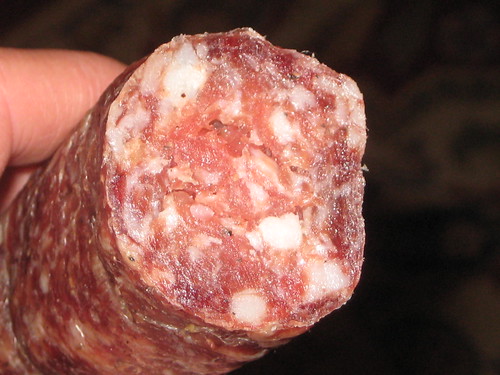
The good news is that the saucissons are fully cured (no raw meat in the middle), but as feared, I think the outside cured too fast given the low humidity level in my basement during the month of January. The resulting saucisson is edible, as I ate several pieces and did not puke or die, but the interior does have a slightly brownish tint which indicates that the exterior dried too fast (this is visible in the photo above). I don't think the interior rotted, because it doesn't smell bad, but I do think it wasn't able to dry evenly because the exterior cured too fast. As a result the saucisson has an off taste which isn't exactly delicious.

Rest assured, I will purchase a humidifier and give it another try. In Minnesota humidity levels are higher in the spring, which should also help. We shall overcome.

Friday, January 30, 2009

saucisson update: going to wait a few more days

I went down to the cellar last night to check on the salumi and I think they still need some more time. We're well past the three week mark, but when I squeeze them there's still a little too much resistance on the thicker parts. I'll check again on Sunday - be prepared.

Sunday, January 25, 2009

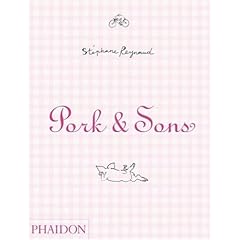
Pork & Sons: a superb cookbook and tribute to the noble pig

For Christmas my wife granted me a copy of Pork & Sons by Stephane Reynaud, a third generation "pork devotee" and butcher/charcutier. If you haven't heard about this book, it is a whimsical French cookbook that also documents the fascinating world of artisanal hog farming, butchering, and charcuterie in France through words and photography. First published in French in 2005, it has been available in English since 2007.

Aside from containing some truly authentic recipes for rural French food (each of which contains pork in some form, of course), this book reinforces the notion that eating meat in an ethical, sustainable fashion does, in fact, assert and celebrate the inherent dignity of animals raised for food. It also exposes, in a succinct and beatiful fashion, the quiet reverence French farmers, butchers, and charcutiers have for the animals they raise, process, and eat. Something most Americans have either forgotten or never known.

"It is fortunate that the standardization of flavor in today's food industry has not yet reached the Ardeche region, where tradition mounts a good defense."

So far I have only cooked one recipe from the book, a delicious take on cabbage soup, but I am anxious to try many more. I'll post the cabbage soup recipe this week, as further proof that you should own this book.

saucisson update: nearly cured!

Just a brief post to let you know that I checked on my saucissons last night and I believe the smallest of the three is nearly cured, with the others shortly behind. As I wrote on Wednesday, the inside of the saucisson was still raw when I sliced one of them (they also felt a little squishy when squeezed). It is still way too friggin' cold and dry, which has kept my basement humidity levels way below the optimum 60-70% range, but it appears the saucissons are drying all the way through without rotting. Tomorrow represents the 21st day of curing, which falls within the timeline recommended by Brian Polcyn and Michael Ruhlman, so I'm planning to perform a slice test midweek - just to be safe...

Thursday, January 22, 2009

saucisson update: on the operating table

I just could not wait any longer. As I wrote on Sunday, the saucissons reached the 35% mark for overall weight loss. This was good and bad news, as it means they might be dry enough to eat, but they also reached that weight in only 14 days (rather than 18-21 per the traditional curing instructions). I have four saucissons hanging, so I decided to slice one to determine their dryness and edibility. They were a little squishy when I squeezed them, which indicated that they may still be a little raw on the interior, but there's only one way to find out. Upon slicing the end off one of them, it was clear that the interior was a little raw. It's very subtle, but in the photograph you can see a slight color variation between the outer third (crimson) and the inside (orange). The good news is that it doesn't appear to be spoiled - it smells like salami.

I hung this one back up to dry for another week. Stay tuned...

Sunday, January 18, 2009

saucisson update: 244 grams, 35% shrinkage :)

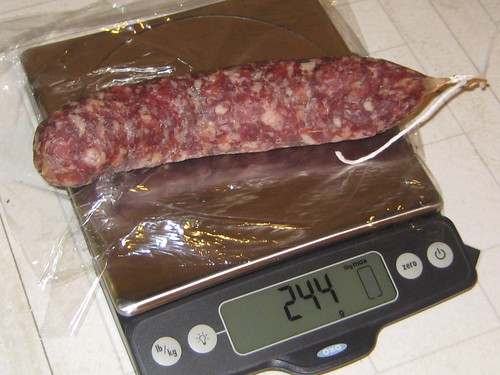
14 days have passed since I first hung these babies out to dry. Can you believe it? I'll bet you've been dying to know. If you read my last saucisson update (and chances are, you didn't), you would know that last week I was somewhat concerned about the rate at which my saucissons secs have been drying. I'm still battling some serious humidity issues, which were compounded by some antarctic temps in MN during the past couple of weeks (as low as -22 F with practically no humidity). Also, the week was very busy for me, so I wasn't able to weigh them until today. I'm glad I did. In my last post (seven days ago), I explained that one of the saucissons weighed 285 grams - today it weighed 244 grams, only 41 grams less. This means that it now weighs approximately 35% less than it did on day one. Not bad.

The recipe said the total curing time should take 18-21 days, I'm going to hold out for a few more days before slicing - just to be safe. Cross your fingers...

Sunday, January 11, 2009

saucisson update: 285 grams and shrinking :(


So exactly one week has passed since I first hung my first four saucissons secs to dry-cure in the basement. To track my products' progress, I decided to weigh them weekly to determine doneness - a fully cured sausage will lose about 30% of its weight over the course of several weeks (the number of which is dependent on the sausage's size, and the humidity and temperature of the space in which it hangs).

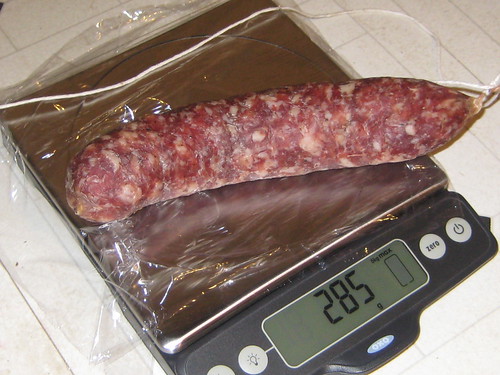
According to the recipe, a smaller link should cure over the course of 18-21 days, meaning it should weight approximately 30% less than it did prior to hanging. I was a little concerned to see that my sausages have nearly lost this amount after only 7 days. The sausage pictured above weighed 380 grams one week ago, and it now weighs 285 grams - 25%. I had a feeling this might happen, as I haven't been able to raise the humidity in the room high enough. With help from a small cool mist humidfier, I was able to bring it up to 55-60%, but it should really be between 60-70% for best results. The biggest risk in this scenario is that the exterior of the sausage may dry/harden too soon, which could trap moisture inside the link, causing it to spoil. To add insult to injury, there's really no way to tell if a saucisson has spoiled without cutting into it.

Given these stats, I'll likely cut into one of these sometime this week, since the 30% mark will arrive soon. I'm already researching a better humidifier. Stay tuned.

Wednesday, January 7, 2009

want to read more about traditional dry-curing?

While looking through a folder of old recipes and and other junk, I found a printed copy of a great article on dry-curing that appeared in the New York Times in May of 2006 (and now that they offer their complete archives, free of charge, I can pass along the link). Entitled, "Dry Cured Sausages: Kissed by Air, Never by Fire," the article documents how this traditional method of food preservation is fading away in the US, particularly due to increasingly restrictive FDA regulations. From the article:

"I would rather go out of business, like all those other guys, than ruin my product by freezing it or cooking it or irradiating it," Mr. Buzzio said.

In case you missed it, my last post details my first foray into dry-curing - the sausages are aging in my basement at the moment.

Monday, January 5, 2009

the gamble: hang $25 of organic pork in your basement

As you might recall, I professed my love of charcuterie to the blogosphere back in June, with a post about making fresh bratwurst for my daughter's first birthday party. Since that first experiment with DIY sausage making, I knew it would simply be a matter of time before I ventured into the realm of dry-curing raw pork, traditional style. I don't have the space to go into great detail on the subject, but it's a fairly simple process with a few, very consequential, nuances. You grind some pork, mix it with some salt and others seasonings, stuff it in casings, and hang it somewhere for anywhere from a few days to six months or more. The nuances are few but critical: absolute cleanliness in all aspects of preparation, the pork has to remain cold during each step of assembly (to retain the right texture), and the dry-curing area must be 60 degrees F with about 60-70% humidity. If it works, a harmless white mold will grow on the exterior of the sausage, which prevents the growth of harmful microbes and contributes to the end result's distinctive flavor. Cool!

I embarked on my first dry-curing effort - a traditional French "saucisson sec" - over the holidays, when I had some extra time to prepare a decent curing area and procure the right ingredients. I've posted the recipe below. Anyone interested in at least learning about these ancient foods should buy one of my favorite books: Charcuterie: The Craft of Salting, Smoking, and Curing, by Michael Ruhlman and Brian Polcyn. In addition to compiling an exhaustive collection of great recipes, they offer detailed descriptions of the required techniques, safety precautions, and equipment.

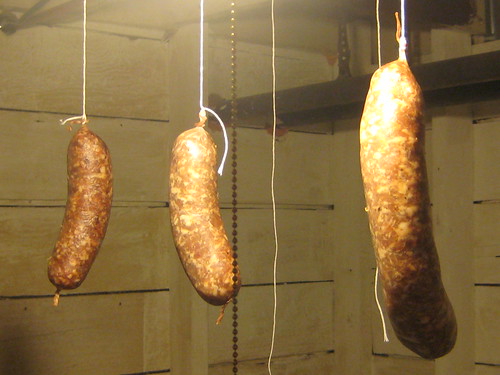
I took the above photo tonight, after hanging my saucissons to dry in an unfinished corner of my basement. I'm using a humidifier to keep the right amount of moisture in the air (Minnesota has very dry winters). Theoretically, they won't be ready to eat for at least 3 weeks, so I'll try to post an update and photo each week to track their progress.

ingredients:

  • 4.5 lbs organic boneless pork shoulder, diced (only boutique hog will work here)
  • 8 ounces pork belly or back fat, diced
  • 3 tbsp kosher salt
  • 1 tbsp coarsely ground black pepper
  • 1.5 tbsp sugar
  • 1 tsp curing salt (which contains sodium nitrite, to prevent botulism growth)
  • 1 tbsp minced garlic
  • 12 feet hog casings or 3 feet of hog middles, soaked in tepid water for at least 30 minutes and rinsed
technique:
  • Grind the pork and fat through the large die into a bowl set in ice.
  • Combine the meat with the remaining ingredients in the bowl of a standing mixer. Using the paddle attachment, mix on the lowest speed until the ingredients are evenly combined, about 1 minute.
  • Stuff the mixture into the casings and twist into 12-inch links. Prick the casings all over with a sterile pin or needle to remove any air pockets and facilitate drying.
  • Hang the sausage (ideally at 60 degrees F with 60-70% humidity) until it feels completely stiff throughout and/or it has lost 30 percent of its weight, 18-20 days for links, a month or more for large sausages.

Thursday, July 10, 2008

recipe: classic german bratwurst

As promised, I'm posting an abbreviated version of the brats we grilled up for my daughter's b-day. I've pulled the ingredient list and steps from the book I mentioned previously, Charcuterie: The Craft of Salting, Smoking, and Curing by Michael Ruhlmann & Brian Polcyn, which contains some additional tips and details.

Ingredients:

  • 3 pounds boneless pork shoulder butt, diced (if you're in MN, buy from Prairie Pride or Farm on Wheels from the St. Paul Farmers' Market)
  • 1 pound lean veal shoulder, diced (could also use venison or beef)
  • 1 pound pork belly or back fat, diced
  • 3 tbsp kosher salt
  • 2 teaspoons ground white pepper (or black, if you don't have white)
  • 1 1/2 teaspoons ground ginger
  • 1 1/2 teaspoons freshly grated nutmeg (very important - check out Penzey's)
  • 2 large cold eggs, lightly beaten
  • 1 cup ice-cold heavy cream
  • 10 feet hog casings, soaked in tepid water for at least 30 minutes and rinsed (I get my from Kramarzcuk's in Minneapolis).
Process:
  1. Combine all the ingredients except the eggs and cream and toss well to distribute seasonings. Chill in a bowl until ready to grind.
  2. Grind the mixture through the small die into a bowl set in ice (note: I use the Kitchen-Aid food grinder attachment, which is an excellent tool, but you could also use an old-school manual grinder).
  3. Using the paddle attachment of a standing mixer (or a strong wooden spoon if mixing by hand), mix on low speed (or stir) for 1 minute. Add the eggs and cream, start the mixer on low, and then increase the speed to medium and mix until the cream and eggs are uniformly incorporated and the sausage appears sticky, about a minute longer. Saute a small portion of the sausage and taste; adjust the seasoning if necessary. (Refrigerate the sausage mixture while you do this.)
  4. Stuff the sausage into the hog casings. Twist into 6-inch links. Refrigerate or freeze until ready to cook. (note: I use the Kitchen-Aid sausage stuffer attachment, which doesn't work very well).
  5. Gently saute, roast, or grill the sausage to an internal temperature of 150 degrees. Yes, do not overcook your sausage. You bought the best all-natural meat, correct?
Try it. You will never look at Johnsonville the same way, if you even choose to look at them.

Sunday, June 29, 2008

can't find tasty, all natural sausage? make your own

For Christmas my parents gave me a book I've wanted for some time: Charcuterie: The Craft of Salting, Smoking, and Curing. Anyone interested in making sausages, among other juicy things, at home would die for this book. I've only made a few recipes thus far, but I've already read the whole thing cover-to-cover. From duck confit to chorizo, these dudes tackle it all.

For my daughter's first birthday, I decided to make a huge batch of traditional German bratwurst for the party we planned. I'll try to post an abbreviated version of the recipe, but you may just have to purchase your own copy. Check out the flickr photo set for more pix from this session...