Showing posts with label eating. Show all posts

Monday, January 4, 2010

holy f. i just read the ingredient list for Cool Whip.

Well, the planets aligned and somehow I ended up with a donated tub of Kraft (owned by Phillip Morris) Cool Whip in my fridge during the holidays. I ate this amorphous whipped topping more than I care to admit during my childhood, but I never really cared to look at the ingredient list. OMFG. Not only is it long and loaded with polysyllabic chemical compounds, but the ingredients fail to include the one substance that most quickly comes to mind. Can you guess which one?

WATER, CORN SYRUP, HYDROGENATED VEGETABLE OIL (COCONUT AND PALM KERNEL OILS), HIGH FRUCTOSE CORN SYRUP, LESS THAN 2% OF SODIUM CASEINATE (FROM MILK), NATURAL AND ARTIFICIAL FLAVOR, XANTHAN AND GUAR GUMS, POLYSORBATE 60, SORBITAN MONOSTEARATE, BETA CAROTENE (COLOR).


Cream! It seems you can have whipped cream without eating cream. Of course, they did manage to squeeze in some sodium caseinate, which is a milk-based derivative, but it seems Cool Whip exists without any naturally occurring ingredients (except water).

Mmmm... Sorbitan monostearate.

Tuesday, June 9, 2009

more great reading about milk

Via the Atlantic Food twitter stream, today I discovered the rowdy food activism blog "Food Renegade." Just this morning, the site featured an extremely informative post deconstructing the benefits and drawbacks of different types of milk, as well as tips for purchasing raw milk direct from farmers. A great read if you like the other articles I posted.

Monday, June 1, 2009

good enough for grandpa: the case for whole milk

I live in a dairy state. To exist in Minnesota without an ice-cold bottle of milk in the fridge is sacrilege. For reasons of both pride and locavoracity, I am saddened by the "big milk" industry's shift away from the Midwest to California, currently the largest milk producing state (with a marketing campaign to match). Our vineyards need some work, but can we at least buy milk from Minnesota or Wisconsin? There are many small, organic producers selling delicious whole milk in our fine communities - try Crystal Ball or Castle Rock.

Despite our milk maid roots, it is always a bummer to discover that most people in this green pasture of a state prefer skim or 1% milk. We should know better, and exhibit better taste. For years we have been led to believe, by this industry and our own federal government, that low fat milk is better for us. Our fat phobic culture has skimmed the flavor and nutrition from the milk we drink, in a misguided effort to be healthy. I mean, what the fuck is non-dairy creamer, really? The thought of this junk made me so mad I looked up the manufacturing process and found some info here. No sir, it is not soy milk.

Now the facts. In the words of Nina Planck, author of Real Food for Mother and Baby:

Whole milk is what is called a complete food, because each ingredient plays its part. Without the fat, you can't digest the protein or absorb the calcium.

The body needs saturated fat in particular (monounsaturated and polyunsaturated fat can't do the job) to take in the calcium that makes bones strong. Milk fat also contains glycosphingolipids, which are fats that encourage cell metabolism and growth and fight gastrointestinal infections.


The all-important vitamins A and D are found in the fat. Historically, whole milk and butter were the best sources of these vitamins in the American diet, which had up to 10 times more of both vitamins than modern industrial diets. In skim and low-fat milk, the vitamins are removed along with the fat, so dairies add synthetic A and D. But Vitamins A and D are fat-soluble; that means they cannot be absorbed into the body unless they're taken in with fat. Thus, even fortified skim and low-fat milk are not nearly as beneficial as the real thing.

To debunk your own low fat milk myths, I encourage you to read two excellent articles about the undisputed health benefits of whole milk, as well as the virtues of its raw, farm fresh form. Nature intended it this way.

Whole Milk is Best, by Nina Planck
This article, which appeared in the New York Times, offers a factual look at the benefits of unadulterated milk, and New York City's efforts to promoted low fat milk in low income communities.

I should note that I found a link to this article on the website for Kopplin's Coffee shop in St. Paul, MN. The owner of this fine shop believes in local, organic whole milk so much he refuses to serve low fat milk in any of this coffee drinks.

Should This Milk Be Legal?
Another NYT piece, this article discusses the growing trend of drinking raw cow's milk. Oh no!

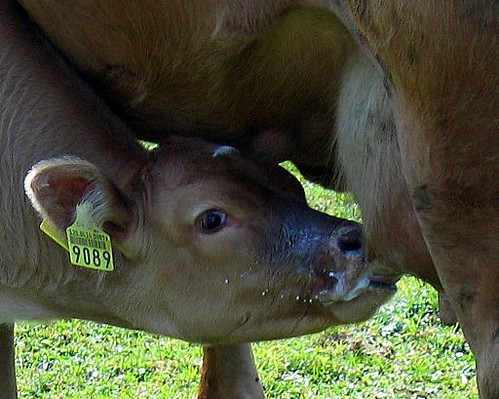
photo: jenny downing on flickr


Thursday, May 21, 2009

La Vida Locavore: A must-read blog

Mark Bittman just tweeted a very provocative link from La Vida Locavore, a food politics blog, which yesterday featured a great post about what children in different countries eat through school lunch programs, and the USA's pitiful excuse for state-sanctioned nutrition.

I haven't read this blog before, but it appears to be one worth visiting.

From the site:
La Vida Locavore is the blog for anyone whose crazy life includes planting, growing, weeding, fertilizing, raising, picking, harvesting, processing, cooking, baking, making, serving, buying, selling, distributing, transporting, composting, organizing around, lobbying about, writing about, thinking about, talking about, playing with, and eating food!

Sunday, May 3, 2009

there is du bon fromage in the U.S.

I have France on the brain. Today I outlined a series of blog posts to document our trip - vegetable markets, butcher shops, fishing, foie gras - but before writing those I must proclaim how satisfying it is to return home and find a truly delicious raw milk cheese fabricated à l'ancien, in Vermont.
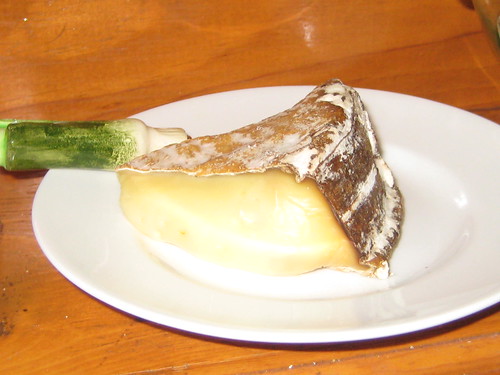
What a specimen! It's a slice of Jasper Hill Farm's "Winnimere Mini," a raw cow's milk, soft rind cheese. You table's cheese course deserves nothing less. The taste is truly unique, of Vermont terroir, but if I had to, I would compare to a Saint Nectaire crossed with a French Munster.

By geographic principle, I am committed to buying artisanal cheeses made in the US; however, many of the better cheeses are typically much more expensive than the majority of French and Italian imports, and they often have less flavor and overall panache. This small slice of Winnimere set me back $4.50, which I feel is a very fair price given the exceptional quality of the cheese - in fact, many less deserving cheeses are sold for much more. Save some fuel costs and buy a big piece of this for your next dinner party.

Monday, April 6, 2009

slow and easy food: hot-smoked pork chops

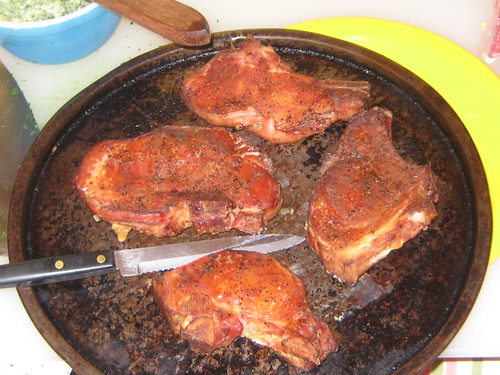
In case you don't follow my dorky tweets about food, you should, because Saturday I posted my first ever live-tweeted recipe and cooking session (see chronology and photos): smoked pork chops! These are so easy, and the flavor will detonate your taste buds. Not surprisingly, it's quite difficult to capture ingredient lists and measurements in 140 characters, so I've posted the full recipe here.

ingredients:

  • 4 thick cut, free range, well marbled pork chops from a local farm (MN-folk should try Pastures a Plenty or Prairie Pride), about 8 oz per chop
  • 1/2 gallon cold tap water
  • 3/4 cup kosher salt
  • 1/2 cup sugar
  • 4 tsp pink curing salt (to buy)
  • 2 garlic cloves, peeled and slightly smashed
  • 2 tbsp chili powder
  • 1 tbsp paprika
  • 1 tsp ground black pepper
  • wood smoking chips (apple wood, hickory, etc.), soaked in warm water
to brine chops:
  1. In a large, non-reactive bowl, place water and pork chops
  2. Run about 1-2 cups of very hot tap water into a smaller bowl
  3. Add kosher salt, sugar, curing salt, and garlic to hot water in small bowl. Stir with a fork until salt and sugar is dissolved.
  4. Pour this mixture into the large bowl and refrigerate for 4-12 hours.
  5. When ready to cook, remove chops from brine and pat dry.
to smoke chops:
  1. Mix remaining spices in a small bowl and apply to all sides of pork chops. Let chops sit on the counter for 30-60 minutes to come to room temperature.
  2. Light about 1/3 of a chimney starter loaded with charcoal briquettes (wood/lump charcoal burns too hot/fast for smoking).
  3. Bank coals on one side of your grill, put the wood chips on top (ideally in a smoker box or wrapped in a foil packet), and place a small pan on the bottom of the grill opposite the coals.
  4. Place pork chops on the grate opposite the coals. Cover and begin smoking.
  5. After about 1 hour, add 10 unlit charcoal bricks to the top of the pile. Cover and continue smoking.
  6. Chops will be ready approximately 1-2 hours later, depending on the temperature inside and outside of the grill. They should be a dark red-orange w/ and be very tender (slight charring on the edges is ok, too).
  7. Rest chops for 5 minutes before serving.
*Serves 4 people

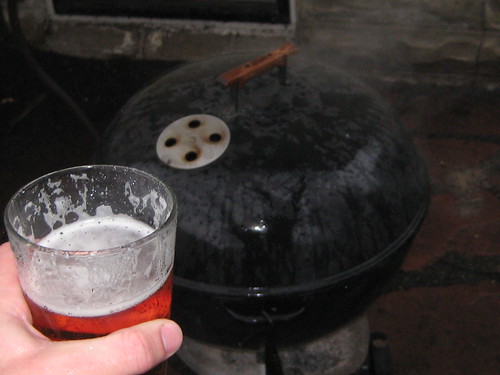
These go really well with a strong beer, some fried or roasted potatoes, and a green salad. Sauerkraut is also an excellent choice, especially in winter.

Friday, April 3, 2009

bulldog update: still no word from the owner!

Nearly one month has passed since I emailed the Bulldog's owner regarding my inquiry, mainly why they were serving lower-quality meats, and a generally less-appetizing menu, in St. Paul. I guess they really don't care about what their patrons think. In fact, someone recently commented on my post that "Bad food is one thing, but a server who asks, 'What do you want me to do with it?' when you tell her your food is bad-- while standing with her hand on her hip as your dreck sits in front of you-- is icing on the cake."

Also, shortly after writing that post I realized that I forgot to mention the Bulldog Uptown and its menu. Sadly, it appears they're serving a similar menu to the Lowertown location. Patrons revolt!

Monday, March 23, 2009

the season's first burger: an essay

All of this blogging about other people's cheeseburgers left me feeling eager to grill some of my own. That, combined with a stretch of warm spring weather and the specific nature of my wife's pregnancy cravings, meant that the ceremonial first-burger-of-the-season would be grilled on Friday. Much to my dismay, what started as a fantasy week of balmy spring weather quickly turned cold, rainy, and straight-up medieval by Friday afternoon. I did not care. With a Summit Maibock in hand, I donned a raincoat and proceeded to load the chimney and brush the grate.

Americans love cheeseburgers. However, our sterile, Walmartian culture has completely fucked up this simple pleasure. In fact, you might say the standard American burger is FUBAR. We have ruined the hamburger patty. We have stripped the cheese of a soul. We have reduced the toppings to bland, watery, and/or chemical soaked afterthoughts. What remains is a previously sickly, previously frozen, previously in a CAFO sandwich-type-thing that is hardly fit for consumption by American pets. I mean that. I seriously mean that. And I'll stop my rant there. You read this blog because you already grind your own grass-fed beauties, right?

Time travel is possible. When you grind your own high quality, grass fed beef you will experience the delicacy enjoyed by many of our grandparents before the convenience age. When you choose to assemble a cheeseburger from the simplest, best ingredients that you can possibly find (within your local food economy), the utilitarian cheesburger is transformed into something truly sublime. Even the French have acknowledged the perfection of a grilled cheeseburger.

The only special equipment you need is a basic meat grinder - I use the Kitchen-Aid grinder attachment, but a manual countertop grinder also works well, and will earn you respect from your bad-ass grandfather.

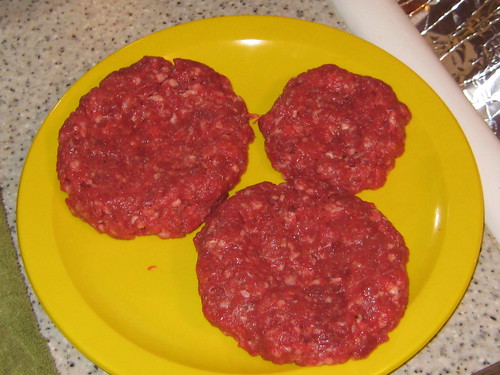
Does your gray, industrial, frozen patty look like this? I think not. So buy some respectable beef and grind your own damn burgers. It will expand your mind.

Ingredients for a burger that transcends time, space, and industrial food culture:

  • 2 lbs chuck roast, from grass fed cows raised by a small local producer (I really like Thousand Hills)
  • 1 tbsp Worcestershire sauce
  • 1 tbsp olive oil
  • freshly ground black pepper, to taste
  • kosher or sea salt, to taste
Technique:
  1. Put your grinder components and two large mixing bowls in the freezer
  2. Trim the beef to remove any tough connective tissue or large pieces of fat (but don't be too surgical or you'll risk grinding meat that's too lean - grass fed beef has very little fat to begin with)
  3. Cut trimmed beef into one inch chunks
  4. In one of the mixing bowls, combine meat with black pepper and salt
  5. Grind meat mixture through the small die into the other chilled bowl
  6. Pour Worcestshire sauce and olive oil into bowl, mix with a wooden spoon until liquids are incorporated (do not over-mix)
  7. Chill the meat in your refrigerator for 15 minutes to keep the meat cold (this is critical) - this is a good time to light the grill
  8. Using your hands, form the meat into 4 equal patties. Each should be about 1 inch think. Press your fingertips into the center of each patty to make them slightly concave (this helps them cook evenly and hold their shape)
  9. Grill over very hot coals until an instant-read thermometer registers 125 degrees (for medium rare). Too squeamish for medium rare? You're missing out. Buying good beef and grinding it yourself means you can eat a correctly grilled burger without fear.
*makes 4 celebration-sized grilled hamburger patties

P.S. Spring and Fall are fleeting portions of the grilling season because the mild outdoor temperatures permit the home chef to prepare some elements of the meal on the grill and some in the kitchen. This is especially important for homemade cheeseburgers and french fries. I do not own a deep fryer (sadly), but my wife and I have learned how to make addictive oven fries using a recipe from Cooks Illustrated. I'll feature our version of that recipe in an upcoming post.

Wednesday, March 18, 2009

extremely fast food: new "pizza vending machine" unveiled in italy

Redefining the concept of convenience food, an Italian business man has just introduced a new vending machine that creates hot pizzas in about three minutes. The pizza-centric "Slice" blog, which is part of the Serious Eats community, posted a photo and additional information earlier this week. Read the full post here.

While Italians typically value high-quality, local ingredients, I don't expect these machines to come stocked with artisanal mozzarella and seasonal, heirloom tomatoes. My advice: buy a slice from a local vendor, which also supports a several local jobs, rather than pumping money into this mass-produced, slightly depressing concept.

Monday, March 16, 2009

buy hydroponic. lettuce.

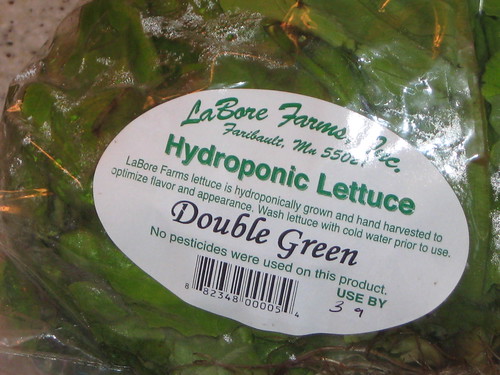
I've had it. I'm not going to buy lettuce from California any more. Picture this: A small head of green lettuce grows in the dirt for many weeks. The lettuce, which is about 95% water, is then picked, washed, and placed in a huge box with hundreds of other heads. The box is placed on a semi trailer with many other boxes of lettuce. The truck drives from some town in California's central valley to St. Paul, MN, where some dude unloads it into the storage room of a grocery store, and someone else puts it in the produce section. Then someone drives to the store to buy it, they return home, and they put it in their refrigerator, where it may wilt before it is ever eaten. This head of lettuce, which, don't forget, is frickin' 95% water, just traveled over 2,000 miles to meet this basic "need." Does that make any sense? It's akin to growing bottles of water iand shipping them thousands of miles to be consumed by someone who already has water. Yes, we do that, too.For that very reason, northern food economies should support more greenhouse and hydroponic produce growers. From May to October, farmer's markets and co-ops carry an excellent assortment of locally grown, outdoor lettuces and leafy greens, but these are clearly not an option in cold months. Hydroponically grown lettuce, by contrast, is extremely versatile because it simply depends on a warm greenhouse and adequate water and nutrients (we have plenty of both in MN, and not so much in CA).

LaBore Farms, a small hydroponic lettuce producer in Faribault, MN recently started selling some value-priced greens at area co-ops and natural foods stores. At approximately $2.99 per bag, these greens are delicious, nutritious and they keep longer in your refrigerator because they only travel about 50 miles to a St. Paul store, vs. the epic transcontinental journey described above. Read more about hydroponic agriculture.

Wednesday, March 11, 2009

the stray bulldog: st. paul diners beware!

Like any blogger I keep an ongoing list of potential post topics, which includes recipes I've used, products I like, and restaurants that are worth writing about, for better or worse. Around the time of the RNC in 2008, rumors began to circulate about a Bulldog opening in St. Paul. Most people I talked to were enthusiastic, as the Bulldog NE has been a huge hit across the river, offering the well-needed combination of a unique beer list and thoughtfully prepared bar food, emphasizing high quality ingredients such as humanely raised Midwest Wagyu beef - more about this later. As a St. Paul resident, blogging about the new location was a no-brainer, as such a bar doesn't really exist in this city (the Muddy Pig comes close for beer, but the food doesn't hold a candle to Bulldog NE).

Anyone who has eaten at the Bulldog NE knows that their burgers are special. As explained on the menu, all burgers are made from pasture-raised Wagyu cattle, which the restaurant grinds in their own kitchen. The result is an expertly prepared cheeseburger, cooked to your preference (where medium rare is actually a rich, juicy pink). At first glance, the Bulldog Lowertown's menu appears very similar, right down to the different types of burgers served. The selections are not a carbon copy of the NE location, but they're arranged similarly.

I've eaten at the Bulldog Lowertown three times now, and overall, I would say the experience was fairly good. The beer list is unrivaled and the tater tots are the definition of munchies. In fact, after eating there the first time I was excited to write a celebratory post describing how this bar is a beacon of hope in the rather bleak downtown St. Paul scene. What ruined that sentiment was not an incident of poor service (though one should read the yelp reviews for Bulldog Lowertown), or singularly bad meal. Rather, I am completely disappointed in the owner's decision to serve lower quality food to the good people of St. Paul, particularly with their burgers. The second time I visited the bar for dinner I took a closer look at the menu, mainly because I didn't recall seeing the word "wagyu" printed anywhere - just the words "100% angus," (words that carries very little meaning these days - MN readers will remember this story).

To gain some clarity around why the menus are different, I placed a call at each restaurant (NE and Lowertown) to ask about the beef they serve, mainly what type it is, where they get it, and why...

Bulldog NE

The woman who answered the phone, who is likely a server, was very friendly and receptive to my question. She confidently explained that the NE location only serves special Wagyu beef from cattle raised in the midwest, which are grass-fed and humanely treated (although not certified organic to her knowledge). All beef is sourced from a small company in South St. Paul called Swanson [no website found], and it is ground in-house at the Bulldog.

She also mentioned that their menu is different from Lowertown; in fact, she said their menu was much more "high end," featuring better ingredients and different recipes. I am not surprised. I have eaten at Bulldog NE several times now and the food has always been solid, with a subtle gourmet edge. If this server's respectful, knowledgeable response is any indication of the restaurant's overall dedication to serving good food, then Bulldog NE should be high on the list of any locavore looking for a sustainable burger and fries, among other good things.

Bulldog Lowertown
In stark contrast, the Lowertown server who picked up the phone initially could not recall where their beef is from, and seemed slightly annoyed by my simple question. However, several seconds later she remembered that "oh yeah, it's angus," which is printed on the menu - so much for knowing more than the customer. When I asked where it came from and if the animals were treated well (such as free range, grass fed, organic, etc.) she asked me to hold so she could ask someone else. It turns out they buy their beef from Shumacher's, a MN-based meat wholesaler, and she didn't "think" it was free range or grass fed, nor did she know anything else about it. She did say that one of their burgers, "The Lowertown" is made with grass fed beef - apparently they use a special blend of meat, sundried tomatoes, etc. that I'm assuming they buy as frozen patties Why else would they only serve one burger that's grass fed? It boggles the mind. Well, perhaps they don't care about differentiating their food from every other thoughtless burger joint around town.

Ok, this post has run on for too long, so I'll sum this up. As a St. Paul resident, I am truly dismayed that the owner of both restaurants has veiled lower quality food under the same brand name in my city. If I decide to eat at any Bulldog again, it will surely be NE because I do care about what I eat and will spend my dollars at a restaurant that cares - in fact, I'm even willing to pay a bit more. Also, I am a marketer by profession, so I understand the need to tailor your offerings to the specific community you intend to serve; however, some brands may not be elastic enough to support too much variation in product quality or service. Quality and consistency are king. I hope St. Paul diners catch on quickly.

P.S. I have emailed the owner directly to ask why they've taken this approach to the St. Paul restaurant. I'll let you know what I hear, if anything...

Tuesday, December 9, 2008

i just have to write about shish

On this busy section of St. Paul's Grand Avenue, a very wise man has reinvented Middle Eastern cuisine in the Midwest. This cozy, sleek little restaurant, simply known as Shish, not only has a solid menu of freshly prepared Middle Eastern staples, but it has managed to produce these dishes using a lot of natural, local ingredients.

With our toddler in tow, my wife and I stumbled into Shish this evening for a quick meal. This was my first time eating there, but my wife had been to Shish once before and was anxious to return.

We spent at least five minutes combing the large menu to make a selection, but the lure of freshly made falafel sandwiches proved too strong. I was particularly eager to try Shish's falafel, as one of my preferred vendors is another St. Paul gem, Abu Nader.

After placing our order, I noticed a sign on the wall promoting an "organic hamburger" special. Despite a recent surge in popularity, it is awfully difficult to locate organic meats in Minnesota restaurants, especially in less formal eateries. I then asked one of the employees if all of their meats were organic or free range, and was told "hold on, I'll ask the manager."

A friendly, excited-looking man appeared, and boldly told us that they only use organic ground beef, and all of their other meats are procured from sustainably minded, local producers. The manager then said "Wait here. I will show you the ground beef." He vanished into the kitchen and returned holding a package of Dakota Beef, which appears to be a reputable Midwest producer of organic beef.

The manager then said: "We buy only high quality meats from local producers, because people come here for the food, and we want to give them the good stuff." Right on.

Needless to say, our falafel sandwhiches were superb, tasting of all the good stuff this little restaurant has so carefully sourced for its patrons.
I don't think they have an official website, but you can find basic info about the restaurant here. And if you have seen their site, please post the url here.

Shish
1668 Grand Ave.

St. Paul, MN 55105

651.690.2212

Update 07/08/09: Shish now has a website.

Friday, November 21, 2008

a sustainable strip club?

I'll start this post by saying that this is the first review of St. Paul's most important new restaurant, The Strip Club, that will not include commentary regarding the clever/cheeky nature of said establishment's name. Love it or hate it, it's what the forward-thinking owners of this beacon decided to call it, and I think we have more important topics to discuss, such as the vittles served within. It should also be noted that the chef and owners are fervent supporters of local foodstuffs, so practically everything served at the place is highly seasonal and grown by local farmers.

I'll keep this small but filling. My wife and I visited The Strip Club for the first time for our fifth wedding anniversary. As young parents, and resident East Siders, we don't leave the house for a fancy date as often as we would like, so this outing carried significance beyond the value of a mere wedding anniversary. That said, we entered the fine old building with only one preconceived rule: "eat and drink whatever you want."

The evening digested as follows.

apperetif #1:
old fashioned - just like grandpa's
moscow mule - refreshing, yet predictable

first course:
foie gras* - this local version of the French classic changed my life
french fries - absolutely perfect

*I'll admit, not all foie gras production is ethical or appetizing, but the Gasset family in Caledonia, MN demonstrates a respectful practice of this ancient technique.

apperetif #2:
old fashioned - no comment
moscow mule - no comment

second course:
grilled caesar salad - warm, crisp, and smoky, this salad redefines entree
spinach, beet, and goat cheese salad - simple and seasonal, a must-order

main course:
bone-in ribeye - an intimidatingly sized portion of the best grass-fed beef. hallucinatory.
NY strip steak (the restaurant's namesake) with blue cheese and scallions - exactly what it should be. a juicy, meaty, thick steak, cooked perfectly (rare to medium rare)

wine:
I don't remember, but it was f'in good.

dessert:
flourless dark chocalate tart (we split it) - not unlike crack/cocaine
some-port-from-Washington - a triumph. the perfect pairing for an illicit dessert

coffee:
single espresso - as it should be

To save you the trouble, I scoured the interwebs to date and collected the most prominent reviews of the Strip Club to date. However, this list does not include the reviews written by The Pioneer Press and Mpls|St. Paul Magazine, who still think it's ok to hide their "archived content."

Star Tribune review
City Pages Dish review
City Pages blog mention
Maria Energia (East Side St. Paul-based green blogger)
Aaron Landry (MN food bloger)

I also found some patron-generated photos on flickr.

Tuesday, October 7, 2008

harvest your own free range, organic, heirloom chickens

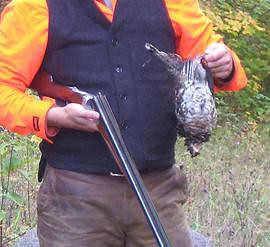
As a stomach driven individual, one of the more fulfilling ways to eat is to participate in each step of the process: harvest, preparation, and cooking. Gardeners know this. Mushroom foragers know this. And yes, hunters know this. I'm saddened by the tension that often exists between people who selectively harvest wild raspberries, and the people who selectively harvest the birds that eat those berries. Hunting is one of my passions, as it's an excellent way to spend time with friends/family, get some exercise, and possibly procure some delicious table fare.

In my home state, Minnesota, we have a plentiful (yet shrinking) amount of wild, open space that supports a massive amount of edible plants and animals. For those of you not familiar with the ruffed grouse, it's basically a wild chicken that lives in new growth forests in the northern United States and Canada. Like other chicken-type birds, ruffed grouse obtain most of their food by searching the forest floor for berries, nuts, tree buds, clover, and other tasty bits. Because they spend the majority of their day on the ground (rather than in the air), their meat and flavor resembles that of a free range, domesticated chicken - white and juicy.

For a long time, Europeans and Americans have understood and respected the utilization of wild food sources, but as lifestyles continue to shift away from local food sources, the perceived importance of ethical, sustainable, hunting practices is waning. This is not to say we should all build our own sod huts and eat only what we kill; rather, it's a matter of revisiting concepts like hunting as part of a broader, sustainable eating culture and philosophy.

To further pique your interest, here's a recipe for the next grouse you procure (either through the sights of your 20 gauge, or the freezer of a friend).

ingredients:

  • one whole grouse (plucked*, with feet and head removed)
  • 2 tbsp high quality butter (softened)
  • 1 tbsp olive oil
  • coarse salt
  • freshly ground black pepper
  • 1 bottle of bold, mildly expensive red wine (how many grouse do you shoot?)
  • one small shallot, minced
A note about plucking wild game: Many people think it's a huge hassle to pluck their game birds, so they skin them. Don't follow their advice - when you remove the skin prior to cooking, you remove the fat (the flavor!) and expose the normally juicy meat to intense heat. Plucking is easy work if you plan ahead. Once the bird is shot, field dress it normally, and find a cool, dark, sheltered location, such as a root cellar, basement, garage, shed, or old refrigerator. Using a piece of string, hang the bird by its feet and let age for 24-36 hours. The secret is simple: soon after the bird is shot, it cools and rigor mortis stiffens the birds muscles, including those that hold the feathers in. By aging the bird, the muscles loosen again, and they can be pulled out with ease. Don't whine. Just trust me.

technique:
  1. preheat your oven to 400 degrees
  2. wash and dry the bird and make sure you've removed any remaining shot (tweezers work well)
  3. smear one tablespoon of the butter all over the bird (inside and out); repeat with the salt and pepper
  4. find a small, heavy bottomed, ovenproof sauce pan or skillet that will hold the bird(s), heat it over medium/high flame, and add the olive oil
  5. once the oil is hot, sear the bird on all sides using a tongs - should be golden brown when you're done (4-6 minutes)
  6. put the pan in the oven and roast for 15-30 minutes (until internal temparature reaches 150 degrees - this is wild game, not some sickly factory bird, so don't worry)
  7. once the bird is ready, put it on a small serving plate and loosely cover with foil
  8. put the pan back on the stove and toss in the minced shallot, saute over low heat for 1 minute (don't burn the f'in shallots!)
  9. add 1/4 cup of the red wine and reduce until the remaining liquid has thickened and resembles a light syrup.
  10. off heat, stir in the remaining tablespoon of butter. then carve the bird and drizzle with the sauce.
  11. pour and drink the remaining wine with elegant-yet-woodsy confidence.
*serves 1 tired, accomplished hunter, or two normal people (as a first course)

Friday, September 19, 2008

from animal, vegetable, miracle: agricultural plant diversity

Headed to the grocery store today? Read this beforehand:

[from page 49 of Animal, Vegetable, Miracle] According to Indian crop ecologist Vandana Shiva, humans have eaten some 80,000 plant species in our history. After recent precipitous changes, three-quarters of all human food now comes from just eight species, with the field quickly narrowing down to genetically modified corn, soy, and canola.


Wednesday, September 17, 2008

diets are not sustainable

Finally, a short, compelling article from the NY Times outlining the current shift from fad, deprivation-style diets to sensible, seasonal meals - that are also enjoyable. Imagine that!

Here's a gem:

The market research firm NPD Group gets a glimpse of national eating habits through the food diaries it has collected from 5,000 consumers since 1980. The percentage of those consumers who are on a diet is lower than at any time since information on dieting was first collected in 1985. At the peak in 1990, 39 percent of the women and 29 percent of the men were dieting. Today, that number has dropped to 26 percent of women and 16 percent of men.

And another:

[...] there are other indicators of a shift in eating habits. In May, the market research firm Information Resources reported that 53 percent of consumers say they are cooking from scratch more than they did just six months ago, in part, no doubt, because of the rising cost of prepared foods.

Sales of organic foods have surged, and the number of farmers’ markets has more than doubled since the mid-1990s.

Wednesday, September 10, 2008

fast food promotions for hospitals are not sustainable

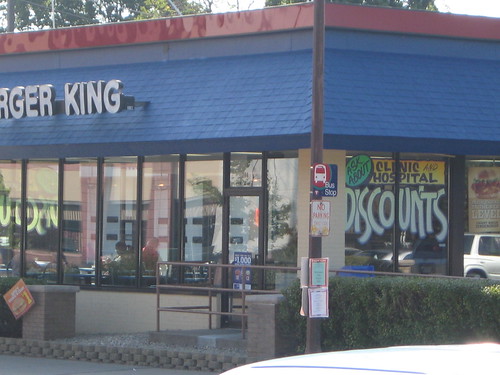
While walking down the street the other day, I noticed a shameless promotion painted on the window of a national fast food franchise, which is located right next to a major children's hospital.


Yes, the sign says: "Ask about our clinic and hospital discounts." Enough said.

Monday, September 8, 2008

a sustainable state fair?

As Minnesotans well know, our state fair just came and went, signaling the end of summer and the beginning of autumn (exciting!). While strolling through the fairgrounds with family, I snapped a few photos of things that represented, even in a subtle way, some of the more sustainable habits of fair organizers and fair-goers.


The two main concert stages (Heritage Square and International Bazaar) are sponsored by local breweries. Heritage Square (my favorite) is supported by Schell's beer, the second oldest family-owned brewery in the US, and Summit sponsors the other stage. There's also the infamous "Leinie Lodge" stage, sponsored by the seemingly local Leinenkugels company in Chippewa Falls, WI, but most people don't know that the beer is actually owned by SAB-Miller (South African Brewing), a multinational beer juggernaut.

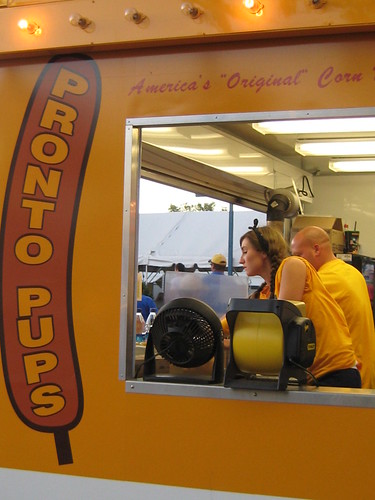
I was pleased to learn that the hot dogs hidden within the classic Pronto Pup (the original corn dog) are proudly made by a small sausage company from Wisconsin. Sadly I don't remember the name of the company.


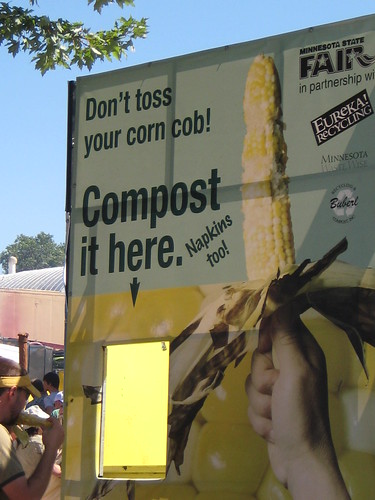
The always busy grilled corn-on-the-cob stand now features a large compost bin sponsored by Eureka Recycling. This is quite significant, as the stand sells thousands of cobs per day, which likely adds up to hundreds of pounds of compostable waste. Most people I saw eating corn put their chewed cobs in the huge, butter soaked bin.


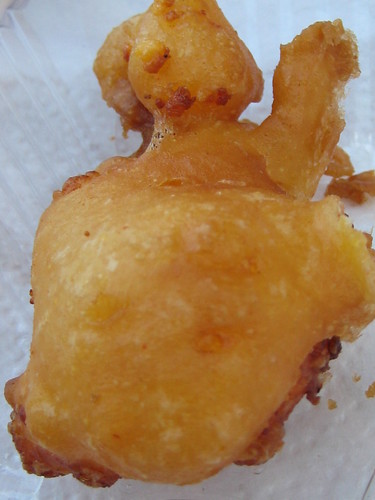
Lastly, many of the cheese curd stands feature cheese from Wisconsin and Minnesota. Have you ever seen a sight more beatiful than a crispy, golden, freshly fried curd?