Wednesday, April 28, 2010

recipe: now is the time to eat your lawn

Every spring, for the past several years, I've been telling myself: "Mark, eat the dandelions in your yard. They're so good for you and I bet they taste great. The co-op is selling them for $3.00 a bunch!" It's a fleeting thought that evaporates with the summer heat, when the dandelions morph from almost-pretty spring flora into desolate, dried-up, seed dispersing weeds. With a new baby and toddler in the house, my approach to lawn care has dropped to historically low levels, if it can be considered "care" at all. The upside is that my small city lot is, quite honestly, a dandelion farm. During times of famine, Italian schoolchildren were sent to the fields to gather wild greens, so why not harvest some from your (chemical free) yard?

This reality most certainly keeps my neighbors up at night, but they're missing out. In fact, they're likely chatting, nervously, about my lawn over a bag of pre-washed lettuce from sunny California. At this time of year, at least in MN, the dandelions are lush and tender, the flower heads just beginning to emerge. Dandelion greens are a great substitute for spinach or arugula, so you can prepare them as you would any other dark leafy green, such as chard, kale, collard green, etc. They even taste great in a salad with vinaigrette.

recipe: sautéed dandelion greens
In recent months I've resorted to increasingly minimalistic techniques to put fresh food on the table quickly, while keeping two little ones out of trouble. Consequently, this recipe doesn't break any new ground, but it will give you an idea of how easy it is to prepare utilitarian sautéed greens, which make an excellent first course, side dish, or leftover ingredient for other dishes like omelets and quiches. It's also an excuse to put down the laptop and weed your yard or garden.

Note: Like spinach, dandelion greens will wilt to a mere fraction of their initial volume, so you can cook a lot of them at once. Just make sure you have enough of the other ingredients to season them well.

Ingredients

  • One large bunch of trimmed, washed, and roughly chopped dandelion greens (two big fistfuls)
  • 2 cloves of garlic, thinly sliced
  • olive oil
  • balsamic vinegar
  • red pepper flakes (optional)
  • coarse salt and freshly ground pepper
Technique
  1. Heat a few tablespoons of oil in a skillet. When smoking, add the garlic and optional red pepper flakes. Cook until garlic is very fragrant (but not brown), about 30 seconds.
  2. Add the greens and stir them quickly as they wilt. Cook until greens are still bright in color, but quite tender (3-5 minutes).
  3. Add a few splashes of balsamic vinegar (to taste), season with salt and pepper, and serve immediately.
*Serves 2-4 as a side dish

Thursday, February 11, 2010

the mother of all potato recipes: tartiflette

We all know I'm a total French food dork, especially of the rustic variety. Over the years I've found that in Minnesota it's quite easy to replicate a lot of the classics with ingredients produced close to home. This is particularly true with the hearty dishes of northern/eastern France, such as Alsace-Lorraine and Savoie (as opposed to Mediterranean climes, of which MN is not).

Tartiflette, a simple, mountain-style casserole of potatoes, bacon, and cheese, hails from eastern France, mainly the Haute-Savoie. The ingredient list appears rather plain, but the results are life affirming. Dare I say gestalt?

I first ate tartiflette while living in a broom closet of an apartment in Paris. One of my neighbors, a young, wily savoyard named Sébastien, was attempting to work in Paris as a baker but he also liked to socialize. His favorite apéritif was vodka with tabasco. Our apartment building was a government subsidized community for students and young workers, and it offered very basic accommodations - most of the apartments resembled single occupant dorm rooms, with shared kitchens and bathrooms. Lucky for me, a shared kitchen meant a lot of time chatting with Sébastien about cooking, eating, and drinking while cooking, eating, and drinking. He first mentioned this dish during an animated conversation about the food of Savoie. Several days later he surprised a few friends by cooking a heroic, multi-course meal of hometown favorites, which included Chartreuse (herbaceous, jet fuel-like booze with a great story), a wild mushroom omelette, tartiflette, ham, and some sort of syrupy cake. It was an education in cold mountain culture.
I neglected to ask Sébastien to write down his recipe, but it just so happens that Anthony Bourdain has a burly, authentic rendition of tartiflette in his Les Halles cookbook. I know, I just posted a recipe based on that book, but each winter I can't keep my oven mitts off his book. It's indispensable during the dark depths of winter, when you need some epic, kill-the-pig-yourself French comfort food. In fact, his description for this recipe consists of only one sentence: "Here's more evidence that you can never have too much cheese, bacon, or starch."

Ingredients

  • 2.5 lbs potatoes, peeled
  • 2 tbsp olive oil
  • 1 medium onion, thinly sliced
  • 1/2 lb slab bacon (or strips), diced
  • 3/4 cup dry white wine (an Alsatian Riesling would work well here)
  • salt and pepper
  • 1 lb wheel of Reblochon cheese*
*Note: Savoyard hackers may infiltrate and tear down my blog after reading this note, but if you can't find Reblochon, or would prefer to buy a local cheese, you could use any soft rind, Brie-style cheese. And I know, the recipe calls for a full wheel, but cheese is the cornerstone of the dish. The other ingredients are quite inexpensive, so it's definitely worth splurging on a big nasty slab of goodness.

Technique
  1. Preheat the oven to 350 F. Place the potatoes in a large pot, cover with water, and bring to a boil. Cook for about 20 minutes, or until the potatoes are easily pierced with a paring knife. Remove from the heat, drain, and let sit until they are cool enough to handle. Dice the potatoes and set aside.
  2. In a large sauté pan, heat the oil over high heat and add the onion. Cook over high heat for about 5 minutes, until golden brown, then add the bacon and cook for another 5 minutes, stirring occasionally. Add the potatoes and wine and season with salt and pepper. Cook for 10 minutes over medium heat, stirring occasionally.
  3. Remove the mixture from heat and place in an ovenproof dish. Place the entire wheel of cheese on top and bake in the oven for 20 minutes, or until golden brown on top and bubbling. Serve hot with buckets of white wine or beer.
*Serves 4-6 as a first course or side.

Saturday, January 30, 2010

finally, a dessert recipe: clafoutis

In the minimalistic spirit of many other recipes on this blog, I bring you clafoutis - easily one of my favorite desserts of all time (and the first dessert recipe on HOUSEKEPT). There are only about five ingredients, all of which you should have on hand, so make it this weekend. I had the distinct pleasure of eating copious amounts of this pudding-like dish while studying in Pau, France. My host mother was from Limousin, a rustic region of France known for cherries, porcelain, and beef. At the time I was completely unaware of this wondrous dessert; that is, until my host mother prepared two of these in late spring when cherries are in season. Essentially a baked custard-like cake, clafoutis tastes a lot like a very thick crepe mixed with fresh cherries.

Clafoutis embodies what a rustic, homemade dessert should be - the effortless combination of a few pantry staples (sugar, eggs, and flour) and ripe, seasonal fruit. Because you mix the fruit into the batter, almost any fruit will work well. Countless cookbooks contain variations on the classic cherry version, but the most common other fruits would be berries, stone fruit (peaches, nectarines), or pears. The traditional recipe calls for kirsch, a cherry-based spirit, but you could also use cognac, armagnac, bourbon, or some other digestif-type booze. Now for the recipe...

After making clafoutis from quite a few different recipes, I think Anthony Bourdain came the closest to what I ate in France (though I really should ask my host mother) in Les Halles, his manifesto of a cookbook. As a stickler, he uses weight instead of volume for the dry ingredients, but you should be able to convert these quite easily. I made it with pears recently, but the same recipe works well for a number of different fruits.


Ingredients
  • 1.5 lbs cherries or other fruit
  • 3 ounces booze (kirsch, cognac, etc.)
  • 1 tbsp butter
  • 4 oz sugar
  • 6 eggs
  • 4 oz flour
  • 1 tsp vanilla extract
  • 1 tbsp confectioners' sugar
Technique
  1. Place the cherries in a bowl and toss with the kirsch. Let macerate for 1 hour.
  2. Preheat the oven to 450 degrees F. Grease a 9-10 inch baking dish with the butter and coat with a pinch or two of the sugar. Place the dish in the refrigerator.
  3. In a large mixing bowl, beat the eggs with a whisk, then add the sugar and beat well to fully incorporate.
  4. Mix in the flour and the vanilla, stirring enough so that all the ingredients are homogenous but without overworking the flour.
  5. Using a rubber spatula, fold the cherries and their accumulated juice into the flour and egg mixture, then pull your dish out of the fridge and turn the mixture into it. Bake in the oven for about 40 minutes, or until a golden brown crust has formed on top. Also, a toothpick inserted into the center should come out clean - no wet.
  6. Dust with confectioners' sugar and serve warm or at room temperature.

Friday, January 22, 2010

recipe: winter herbless pesto

As you may have noticed, I haven't written nearly as much over the past few months, and the recipes I've published are quite spartan. This is because we had our second child, a boy, in October, and it's hard enough to cook something healthy, much less write about it. However, I am learning a lot about (and practicing) fast, wholesome, winter meals, such as the broiled eggs I wrote about earlier this month. Some people fall to convenience foods during such times, but I choose to strip down my cooking even more.

Yesterday I think I perfected what may be the perfect two-young-children-cold-winter-weeknight-that-you-could-still-serve-company meal: pasta with an herbless pesto sauce. One of the many challenges of cooking with small children is a sudden decrease in trips to the co-op. Combine that with a lack of fresh local produce, and one begins to find new romance in the pantry. After you make this one time you'll be able to make it blindfolded, without a recipe or planning.

Ingredients

  • 1 pound dried pasta (whole wheat spaghetti or penne taste great with this)
  • 1 large garlic clove
  • 1/4 lb parmesan or other hard cheese, plus more for grating
  • 1 heaping cup of walnuts, toasted
  • 1/2 cup olive oil
  • 1 tsp dried oregano
  • 1 tsp coarsely ground black pepper
  • pinch of sea salt
Techinique
  1. In the small bowl of a food processor, fitted w/ a blade attachment, combine garlic, cheese, walnuts, oregano, pepper, and salt. Pulse until the mixture resembles coarse breadcrumbs.
  2. Turn the food processor on and add olive oil until mixture resemles an oily paste (much like basil pesto).
  3. Cook pasta, drain, and toss briefly with the pesto sauce. Top individual plates with grated cheese.
*Serves 4 as a main dish or 6 as a first course.

Saturday, January 9, 2010

broil your eggs for a change

The word "broiled" isn't the finest or most elegant, but the eggs that result from this recipe surely are, with very little effort. This is a great recipe for house guests, or a leisurely brunch with your mate sans children (although, kids like these eggs, too). I found this recipe in Ina Garten's Barefoot in Paris cookbook, which I received as a gift from a good friend who also loves to eat. It's a very concise book that serves as a thoughtful introduction to French cooking, with an emphasis on simple, beautiful food, such as this dish.

As with most egg recipes, the key to this one is timing. The cooking times listed below work well for my oven and baking dish, but it will take you a few tries to perfect this recipe. The good news is that these eggs still taste good slightly overcooked, so don't worry if you miss the mark. It's also critical to use the best eggs you can find, since there isn't much else in the dish - 99 cent CostCo eggs will taste like 99 cents.

ingredients

  • 8 very fresh, large eggs (organic, free range if at all possible)
  • 1/2 garlic clove, minced with a knife (don't use a press, as it will taste too strong)
  • 1/2 cup finely (and freshly) grated super-hard cheese, such as Parmigiano-Reggiano
  • 1 tablespoon fresh herbs, minced (thyme, rosemary, basil, or parsley work well)
  • 2 tablespoons cold butter
  • 1/4 cup heavy cream
  • kosher salt and black pepper
  • 8 slices of crusty bread (toasted or warmed)
equipment
  • 4 small gratin dishes (just large enough to hold 2 eggs) or a ceramic/glass baking dish (large enough so that 8 eggs are about 1.5 inches deep).
*I use a baking dish because I don't have gratin dishes, so the process and timing described below may not work as well for several smaller dishes.

technique
  1. Preheat your oven using the broil setting (Note: my oven has a drawer-style broiler, below the main oven space. When I set it to broil the drawer and oven heat up, which is useful in this recipe.)
  2. Using a fork, mix the garlic, herbs, and cheese in a small bowl until well combined.
  3. Liberally grease the gratin dishes or baking dish with some of the butter. Pour in the cream so that it covers most of the bottom of the dish. Cut the remaining butter into small pieces and scatter these around the baking dish. Place the dish in the oven and heat until the cream begins to bubble and brown slightly around the edges, about 5 minutes. Remove from the oven and place on stove top.
  4. Carefully crack the eggs into the dish so that the yolks remain whole. Try to keep them evenly dispersed. Sprinkle them with salt, pepper, and the cheese/herb/garlic mixture.
  5. Place the dish in the oven and bake for about 5 minutes, or until the whites begin to set up but the yolks and tops of the eggs are still liquid.
  6. Move the dish into to the broiler drawer and cook 2-4 additional minutes, or until the top has browned slightly, the eggs are somewhat firm (it's good if the whites are a bit runny), and the yolks are still soft (some yolks may be softer than others - that's ok). This is the part of the recipe that takes the most practice, as it's really a visual judgment. Keep in mind that the eggs will continue to cook in the hot dish after you remove them from the broiler, so use a knife to see how thorough they're cooked and check them again after resting on the counter top for a few minutes.
  7. To serve, use a knife to cut eggs into sections and use a spatula to gently place them on plates with the bread on the side.
*Serves 4 people

Monday, January 4, 2010

holy f. i just read the ingredient list for Cool Whip.

Well, the planets aligned and somehow I ended up with a donated tub of Kraft (owned by Phillip Morris) Cool Whip in my fridge during the holidays. I ate this amorphous whipped topping more than I care to admit during my childhood, but I never really cared to look at the ingredient list. OMFG. Not only is it long and loaded with polysyllabic chemical compounds, but the ingredients fail to include the one substance that most quickly comes to mind. Can you guess which one?

WATER, CORN SYRUP, HYDROGENATED VEGETABLE OIL (COCONUT AND PALM KERNEL OILS), HIGH FRUCTOSE CORN SYRUP, LESS THAN 2% OF SODIUM CASEINATE (FROM MILK), NATURAL AND ARTIFICIAL FLAVOR, XANTHAN AND GUAR GUMS, POLYSORBATE 60, SORBITAN MONOSTEARATE, BETA CAROTENE (COLOR).


Cream! It seems you can have whipped cream without eating cream. Of course, they did manage to squeeze in some sodium caseinate, which is a milk-based derivative, but it seems Cool Whip exists without any naturally occurring ingredients (except water).

Mmmm... Sorbitan monostearate.

Tuesday, December 15, 2009

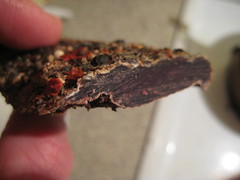
easy charcuterie: dry-cured duck breast

Do you like cured hams? I like cured hams. Prosciutto, Serrano, Bayonne. Salty, sweet, funky hams. Unfortunately for the home charcutier, a good aged ham requires about a 20 pound hog leg and at least six months of time - not to mention a climate controlled drying chamber. However, one can apply the same concept to a simple boneless duck breast, either wild or farm raised. Duck meat, especially the breast, has an exquisite earthy sweetness that shines after a good curing.

Several years ago I stumbled across a very simple cured duck breast recipe in Mario Batali's Babbo cookbook. Just pat it dry, roll it in salt and spices, and hang for about 10 days. I've been waiting for a surplus of duck to use for this recipe, but I only hunt waterfowl a few days per season, so I've never had more than one or two birds to eat. This year the waterfowl hunting gods blessed me with a very fast morning, so it seemed like a good time to cure some duck. The results were quite tasty.

I'm guessing wild goose would work equally well, perhaps even better given its larger size and thickness. In fact, Hank Shaw has a tantalizing recipe for this on his fantastic wild cookery blog.


Recipe: Dry-Cured Wild Duck Breast

Ingredients

  • 2 split wild duck breast (4 pieces)
  • 4 tablespoons kosher salt
  • 3 tablespoons freshly ground black pepper
  • 1 tablespoon sugar
  • 1 tablespoon hot red pepper flakes (use less if you can't handle heat)
  • 1 tablespoon chopped thyme leaves
Technique
  1. In a small bowl, combie the salt, pepper, sugar, red pepper flakes, and thyme. Coat the duck breast with this mixture, wrap it loosely in wax paper and refrigerate for 2-3 days.
  2. Unwrap, wipe off most of the seasoning. Punch a small hole on one end of the breast and tie a length of twine long enough to hang from your cool basement ceiling or refrigerator shelf.
  3. Hang the breast in a cool, dark, semi-humid place (an unfinished basement in winter works well) for 1-2 weeks, or until the breast shrinks to nearly half its original size and feels quite firm to the touch. When sliced, the breast should be wine colored and have a nice, hammy chew.
Serve the duck sliced very thin with cocktails on a salumi plate or as part of a creative first course - Mario Batali likes it with white beans.

Wednesday, November 18, 2009

woodcock: the other red meat.

Minnesota is a blessed place for a number of reasons, including an abundance of native wildfowl. Most people have heard of ruffed grouse, but what about Scolopax Minor, the noble woodcock? I recently heard a wonderful NPR interview with Clotilde Dusoulier, a young Parisian food blogger who translated Je Sais Cuisiner, an epic French cookbook, into English. I don't yet have this book but it has since risen to the top of my personal Christmas gift list. During the interview Clotilde describes how the book was intended to help a new bride cook simple, traditional French food for her new family. Among other interesting bits, she mentions that the author included recipes for some obscure dishes, some of which include wild game, because the polite cook must know what to do with a delicious wild boar or woodcock if an uncle happens to leave one at the house. You should be so lucky.

Woodcock is perhaps the most fleeting of Midwestern delicacies. Each fall, the mysterious upland birds migrate from the Northern US (mainly the Upper Midwest and New England) and Canada to the Southern states for the winter. Native Minnesota birds can be found throughout October, but large concentrations of migratory birds are only in the state for 2-3 weeks, depending on the weather, which adds to their allure as game. Their bodies are about the same size as a quail but they have a long neck, large black eyes, and a long pointed beak designed to dig in the soil for earthworms. With a taste that loosely resembles wild duck, Woodcock are truly glorious if roasted simply in a hot oven. To fully appreciate the mystique and obsession surrounding la bécasse, particularly in Europe, I recommend reading this web page. Not surprisingly, the French are the most rabid fan club, but Woodcock also are held in high esteem in the UK.

There are a few classic preparations for woodcock, most of which are mentioned in the Larousse Gastronomique. This is a variation on one of the most typical techniques.

Ingredients

  • 1 whole woodcock, plucked
  • 4 tablespoons of delicious butter, softened
  • coarse sea salt (French grey is very good for this)
  • coarsely ground black pepper
  • 1 tablespoon olive oil
  • 1/2 cup of equally scarce red wine
  • 6-8 baguette slices
Technique
  1. Preheat oven to 400 degrees. Smear the inside and outside of the bird with 2 tablespoons of the butter, making sure the breasts are well coated. Sprinkle generously with salt and pepper, again, inside and out.
  2. Heat the oil in a small heavy-bottomed sauce pot over medium heat. When it begins to smoke, add the bird and brown on all sides (about 5 minutes total).
  3. Transfer the pot to the oven and roast 10-15 minutes, or until the bird is golden brown, and the inside is hot to the touch. Important: Like duck, woodcock must be served rare or medium rare to retain its wonderful texture and flavor. The breast should be blood red when you slice it, but not cold (it's not sashimi).
  4. Put the bird on a cutting board to rest. Pour out all but one tablespoon of the fat in the pot and heat the pot over medium flame. Deglaze the pot with the wine, making sure to scrape everything tasty off the bottom. Let the wine reduce to a light, syrupy sauce. Then remove from heat, whisk in the butter, and check the seasoning.
  5. Pull the legs off of the bird and eat them while you finish the dish (with a fat glass of wine).
  6. Remove the breasts from the carcass and slice them thinly. Top the baguette slices with the sliced meat, drizzle with sauce, and sprinkle with a pinch of sea salt.
*This makes 6-8 canapés to share, or a small meal for one.

A dish this special deserves an equally special wine. The French recommend a big, bold, dry red wine. I don't argue with them. There is even a French vineyard, Domaine de la Mordorée (Chateauneuf-du-Pape), that celebrates the elusive woodcock on its bottle labels. I drank this with a woodcock I ate last year and I won't ever be the same.

Tuesday, September 22, 2009

grocery wars

I'd prefer to write about this epic struggle, but one can only dwell in fantasy for so long. The top business story in Sunday's St. Paul Pioneer Press, "Food Fight," details the present landscape of mainstream grocery stores in our oft named battleground state. Well written and detailed, the piece describes how grocery market share in MN has changed over the past few years, particularly in the Minneapolis/St. Paul metro area.

The overarching trend discussed in the article is clear: huge, extreme discount stores - mainly Walmart and Target - are attracting more and more shoppers away from Minnesota-based or regional chain stores, such as Kowalski's, Cub Foods, and Rainbow Foods. Many key issues are addressed, including unionization, loss-leaders, and extreme discounting (Walmart vs. Cub). Aside from the fact that co-ops and co-op-like stores aren't mentioned in the article, the most interesting part (for me) is the perspective offered by and about smaller grocery retailers, such as Kowalski's. Here's an excerpt:

The nine-store Kowalski's strategy is to hunker down, focus on quality and see when the economy improves, said Jim Kowalski. "We're not doing any growth right now," he said. "We don't pretend to compete in the price wars that seem to be going on."


Let's face it. There are at least as many types of grocery shoppers as there are brands of frozen pizza at Cub Foods (which was 27 last time I checked). Some people are loyal to one store, at which they buy everything. Others play hopscotch with several retailers, buying different items across multiple stores. Still others are perhaps a bit more schizophrenic, shopping at a different store depending on immediate geographic location (work, school, neighborhood) or emotional state (indulgent, frugal, or green). Such is the state of our food culture.

I am not a grocery store business expert or analyst, but I do buy a lot of food and attempt to follow these trends closely. To date, I have spent money at nearly every grocery retailer mentioned in the article, the exceptions being Aldi's/Trader Joe's and Walmart/Sam's Club. However, for the past 5 years or so, I've chosen to abandon corporate grocery stores in favor of co-ops, of which there aren't nearly enough. That's a different blog post altogether.

What if the challenge Kowalski's faces is an opportunity? A crowded market is dangerous for business as usual, so perhaps the time is right for some lasting innovation among smaller grocers. Jim Kowalski's quote acknowledges that his stores, despite their focus on "quality" (whatever that means), cedes a defeatist outlook by using expressions like "hunker down" and a lack of "growth." He claims to not "pretend to compete in the price wars," but his market share has decreased as a result of shoppers migrating to newer, bigger stores. He doesn't compete because he can't, at least not solely on the price of Brazilian orange juice concentrate, yet he would like to open additional stores.

Fundamentalist discount shoppers seek the lowest prices on food products, without much (or any) regard for the costs associated with producing, distributing, or selling those products, such as the energy (e.g. gasoline), environment (e.g. chemical pesticides), and community (e.g. wages). Smaller grocers should forget about these people. They live on a different planet or will have to soon.

Rather than use the same vocabulary and approach to growth (i.e. increasing profits, number of stores, and market share), smaller grocers should be and celebrate what the super stores are not: progressive, community-building organizations that sell healthy, fairly priced products (a lot of which are local) and create sustainable, livable jobs. If the tremendous growth of farmers' markets is any indication, there is an increasingly vocal segment of the grocery-buying public that seeks a different choice. Find them and sell them what they want. Co-ops have figured this out, so why can't the local supermarket? Such an outlook may squash a regional executive's dream of creating the next national chain store, but within a different framework, that executive no longer will be needed, and neither will the additional 5 stores he or she hoped to open. A small, efficient neighborhood store can hold a reasonable monopoly. Why must we always need more?

Here's an idea. Maybe the Kowalski's in Stillwater could sell meat, dairy, and produce from the St. Croix river valley, and the Grand Avenue store could sell products from Gardens of Eagan. Add a kick-ass bulk section and show people how to use it. If you can't compete on the price of Tyson chicken fries, then sell real chickens from Callister Farm. Think differently. Yes, these products cost more, but an educated customer understands and appreciates the quality of such products. If I want to find the lowest price on crap I will travel to the cheapest crap heap, of which there are many.

Perhaps a plant analogy is appropriate: grow and manicure a small but healthy bonsai that lives for 200 years, rather than 10,000 acres of wood-pulp aspens to be harvested en masse, or consumed by fire, in a few short decades.

Friday, September 11, 2009

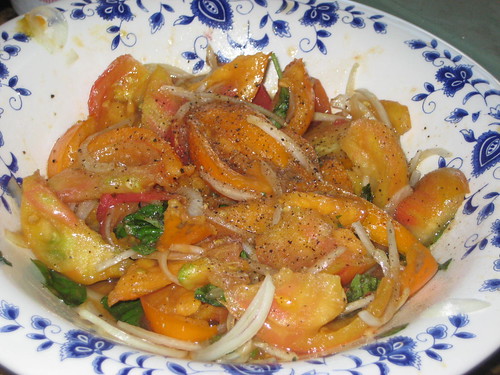
reicpe: french tomato salad

During the juicy splendor of late summer/early fall, insalata caprese is often the default mode of consumption for fresh slicing tomatoes. It is a truly wonderful salad. However, to add some variety to your repertoire, culturally and technique-wise, try this minimalist French version, which is more or less the same recipe that appears in Anthony Bourdain's Les Halles cookbook.

recipe: french tomato salad (salade des tomates)
*Serves 4 as a first course salad, or 6 as a side.

ingredients:

  • 2 lbs perfectly ripened heirloom tomatoes (don't mess around)
  • 2 shallots or one very small onion, sliced paper-thin
  • handful of basil or parsley leaves, cut into chiffonade
  • 1 garlic clove, slightly smashed
  • very coarse sea salt (fleur de sel would shine here)
  • coarsely ground black pepper
  • strong tasting olive oil (my new favorite is Napa Valley Naturals)
technique:
  1. Using a very sharp chef's or tomato knife (I'm not a fan of specialty knives, but this is a useful one), cut the tomatoes in half, remove the cores, and slice the halves into wedges.
  2. Place tomatoes in a large colander (positioned over a bowl or the sink) and sprinkle with a good amount of salt (a word of caution: salt preferences vary, and you will brush some of it off later, but don't go overboard the first time you make it. You can always add more salt before serving). Let them sit at room temperature for 10-20 minutes. Water and seeds will begin to drain through the colander.
  3. Put the sliced shallots or onions in a small bowl and sprinkle with salt. Let them sit with the tomatoes.
  4. Remove tomato wedges from the colander, scraping any loose seeds out with your fingers, and put them in a wide, shallow serving bowl or dish. You also can brush off any large granules of salt.
  5. Add sliced onion/shallot to the bowl, brushing off any excess salt.
  6. Add the basil and drizzle everything with a generous amount of olive oil. Then drizzle with a smaller amount of vinegar. The key here is to minimize the amount of liquid in the salad, as you want the flavors to be intense. The tomatoes should absorb most of the oil and vinegar, and release a minimal amount of juice into the bowl.
  7. Toss lightly with a spoon, top with black pepper, check seasonings, and serve.

Wednesday, September 2, 2009

reinvent your appetite: the relative value of local food

Last week, the Minneapolis Star Tribune contained a short article about the cost of eating as a locavore - "Making the local food movement accessible." Written by Hayley Tsukayama, a grad student, the piece describes how the author seeks to eat more local foods but also maintain a trim grocery budget. Here's an excerpt:

"I was so excited that I forgot a key fact: I'm a single, omnivorous graduate student who normally buys groceries at Wal-Mart. And while the local produce at most farmers' markets is the same price or cheaper than at supermarkets, the meat is far more expensive. I believe that good food is worth the higher prices, but after rent and student loans it's hard to finance a foodie habit."

I'll start by saying that I'm not a big fan of the word "foodie." In a creepy way, it reminds me of the Crucible-era word "goody." Besides, it's too cute, and helps stoke the fire that enjoying high quality food is somehow elitist. By our pitiful standards of nutrition, anyone living in rural France or Italy would be a foodie - "those people make their own pesto!" As an unhealthy society, we should shun these words in favor of "healthy," "high quality," or "whole" foods, prepared from scratch (either at home or at a restaurant). Perhaps the verb "to cook" could see a renaissance.

Enough semantics. What I find interesting about this article is the frequent supposition that "going local" is simply a matter of plugging local products into the American discount "menu" and Walmart "more for less" value equation. Quite literally, we're looking at apples and oranges; or rather, locally-grown Minnesota apples (eaten in season) and dry, industrial orange-like organisms.

Eating healthy, delicious, simple food is possible at any budget. Rural, agrarian communities around the globe have demonstrated this for hundreds of years. In my opinion, one of the biggest issues is that many Americans are reluctant to adopt a healthier, more sustainable diet because it requires eating different foods and much less of certain things, such as meat.

For example, Americans eat a lot of bacon and pork chops. When you make the decision to eat local, pasture-raised pigs that are humanely treated and minimally processed (with care), it will cost more than buying a frozen mass of industrial chops from a huge company. Get over it. What this means is that you may only be able to eat pork chops once a month rather than every Wednesday. The same is true for bacon. At $1.99/pound for industrial bacon, the average person could eat bacon every morning and not go broke. Spend more on some high quality bacon and eat just a few slices on the weekend with pancakes or dice and toss it with pasta. It is time for Americans to revere high quality meat as a precious, scarce delicacy.

The same is true for other parts of the American meal. Bulk, organic oatmeal is very affordable. So is polenta. Dried pasta and rice have kept people satisfied and proud of their food culture for centuries. Remember your grandma's beef stew recipe or your aunt's green curry recipe? Perhaps it is time to rediscover these simple foods as the basics, and combine them with small amounts of more costly ingredients, such as meat, cheese, butter, milk, and olive oil. Throw some seasonal vegetables in a salad or on the side and you will enjoy a trim grocery budget, better tasting meals, and a higher quality of life. I promise.

In the author's defense, the people she interviewed suggested some novel, paradigm-shifting habits, such as eating less meat, so the article does offer some thoughtful perspective from different people who do know something about this. It also generated a number of comments - take a look.

Friday, August 21, 2009

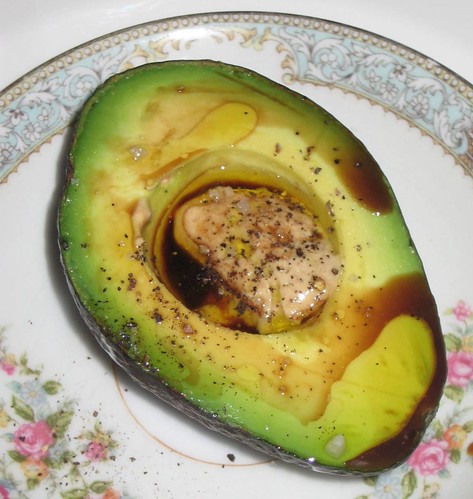
anti-recipe: f'in simple avocado hors d'oeuvre

Rule #1: Don't freak out about hosting friends or family for dinner. Your boss, priest, or Secretary of Defense? Sure. Your best friends? Non.

Rule #2: Cooking and eating are fun, so enjoy the process as well as the results.

Rule #3: Make something that is easy. This will give you more time to clean your bathroom and have an apéritif prior to your guests' arrival. Both of those things are important. This avocado dish is good practice.

I first tasted this exquisitely simple creation as a student in southern France. I know, it sounds pretentious, but as a French major it was necessary to learn grammar in person and increase my vocabulary of regional foods and drink. This included, among other adventures, spending a couple weekends at a French friend's parents' home in Landes. Seeing that I am quite a large individual, my friend's mother immediately implied that the size of my appetite must surely equal or exceed that of my physical stature. She was not mistaken.

As part of a massive late spring meal, she served avocados, halved lengthwise on small plates. She put a small amount of hot Dijon mustard in the center of each, then drizzled some balsamic vinegar and olive oil, and sprinkled some coarse sea salt and black pepper. Just looking at these made me excited. As a Minnesotan, I was not accustomed to eating many avocados, and surely not as an elegant hors d'oeuvre. Eat them with a small spoon and watch your guests drool.

What is this preparation called, you might ask? I do not know. She may have referred to them as "avocats" (avocados), because French people eat stuff like this every day. Let's give it a sophisticated name, to score you points. How about "avocados balsamiques?"

Saturday, August 15, 2009

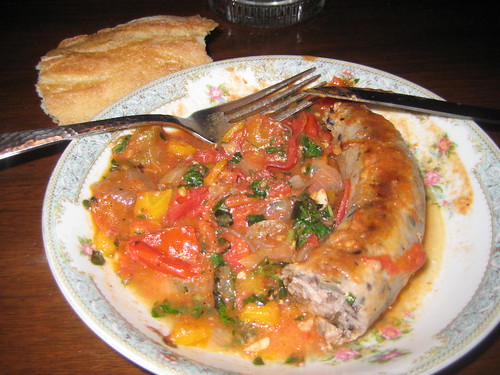
recipe: rustic tomato sauce and sausages

Walking through the White Bear Avenue farmer's market last Wednesday, we found a pile of roma tomatoes for just a few dollars. The heirloom slicing tomatoes in our garden are finally starting to ripen, so it seemed appropriate to use the romas for something cooked. We don't plan meals for the week as well as we should, but in the summer it's usually easy to slap something together with whatever we buy at the market. The following day I remembered reading an easy tomato sauce recipe in Mario Batali's Molto Italiano cookbook (a favorite). This, served with some wild rice pork sausages from Pastures a Plenty and a baguette, turned out to be a great weeknight dinner that also tasted great the following day.

Mario's original sauce recipe is intended for more traditional pasta applications, and calls for canned or skinned/seeded tomatoes, so I cut a few corners to make a more rustic version with chopped whole tomatoes. It's perfect for weeknights or lazy weekends.

rustic tomato sauce and sausages
*serves 4 as a main course or 6-8 as antipasto

ingredients

  • about 2 pounds fresh, locally grown (important!) tomatoes, roughly chopped - if good tomatoes are not available, a high quality canned variety will work
  • 1 onion, diced
  • 1 cup diced carrots (1-2 large, or 4-6 small carrots)
  • 4 cloves garlic, minced
  • 2 cups fresh basil leaves, chopped fine
  • 2-4 tablespoons of other fresh herbs (thyme, rosemary, oregano, parsley, etc.)
  • olive oil
  • hot red pepper flakes (optional)
  • 4 large uncooked pork sausages, dried with a towel, then dredged in flour
technique
  1. over high flame, heat about 1/4 cup of olive oil in a wide skillet until just smoking
  2. sauté onions, garlic, and carrots until soft and translucent (8-10 minutes)
  3. while vegetables are cooking, heat another skillet over high heat with 1 tbsp of olive oil and sear sausages on all sides until deep golden brown (8-10 minutes)
  4. lower heat to medium, add tomatoes and cook until tomatoes are very soft and everything resembles a very chunky sauce (probably 10-20 minutes)
  5. gently lay sausages in the sauce and simmer over low heat for another 10 minutes, until sausages are cooked
  6. after removing sausages from skillet, stir the herbs into sauce (off heat)
  7. plate the sausages, pour some sauce on the side, and drizzle with some oil
  8. serve with bread and a spicy dry red wine


Saturday, July 25, 2009

the organic salon: a review (and $20 coupon giveaway!)

I'll begin by confiding that I'm a Horst Rechelbacher admirer. As a Minnesotan, I derive a great sense of pride from knowing how fortunate we are to have such a visionary in our midst (technically, Horst lives across the St. Croix river, in Osceola, WI, but his businesses are located in MN). Furthermore, Aveda Corporate headquarters is located in Circle Pines, the suburb of my youth. If you're not too familiar with Horst or his endeavors, I recommend reading his Wikipedia entry. After selling Aveda to Estee Lauder in 1997 for an estimated $300 million, Horst focused more intensely on the fledgling Intelligent Nutrients (IN) brand, through which Horst has developed a complete line of organic health and beauty products, and more recently, a full service salon run out of the IN flagship store on Hennepin Avenue in NE Minneapolis.

Intelligent Nutrients products are truly awesome. If you like the Aveda line, but are seeking products that contain only natural plant/mineral ingredients (akin to Dr. Haushka), you will love IN (Aveda products do contain a number of harmful compounds, despite the earthy ethos of the their brand). But enough about the products, as this post is dedicated to the new salon, dubbed Intelligent Hair and Skin, which Horst claims is "the first ever USDA certified organic salon."

At this point you might ask: "So why should I care about an organic salon? I'm not going to eat the pomade." It is precisely that attitude which Horst hopes to transform. His new mantra: “What we put on our bodies should be as safe and nutritious as what goes into our bodies,” is not necessarily a new concept, but in true form, he is pushing it further into the mainstream.

If you signed up for IN email promotions earlier this year, you would have received a coupon for 30% off all of services (color, highlights, hair treatments and facial waxing) and a 20% discount on all salon products. A men's haircut starts at about $35, which is only a five dollars more than I currently pay, so this discount was clearly a deal for me.

Overall, the experience was great, easily worth more than the $35 sticker price. Upon being greeted at the door, I was offered a small glass of orange juice mixed with IN's Intellimune Oil - quite refreshing and exotic. My stylist, Catherine, appeared soon thereafter, and she led me into the small salon space, which is in the same room as the store. I'll admit, I've never had a facial treatment before (nor have I sought one), but a "mini" facial/massage is included with a haircut. Over the course of at least 15 minutes, the stylist massaged my head, and used several aromatic products to endow my mug with a "soft glow." Never again will I poke fun at such activities.

The massage/facial really was enjoyable, and left me feeling slightly euphoric upon sitting down for the haircut portion of the experience. Catherine proved adept at cutting hair quickly and stylishly. I didn't schedule the appointment with the intention of adopting a radically new style, the visit was more of a trim, but it was a great cut nonetheless. No gimmicks or overly earnest suggestions, just a quiet, relaxing haircut.

In writing this, I'm not trying to tell you that IN is the only place to get a great haircut - there are quite a few places where one can do that - rather, it is an experience that recognizes the many facets of wellness and well-being, such as the products with which one chooses to slather their hair or skin. These things do matter, and IN is a wonderful, locally-grown place to learn more about them.

And the giveaway? If you get a haircut at the salon, they'll give you several $20-off coupons to pass along to people you know. I have three of them left, which I'll mail to the first three readers who write a thoughtful comment below. The only requirement is that you live in MN/WI, or plan to visit Minneapolis sometime soon.

Friday, July 24, 2009

1 chicken = 4 meals - part 3

By now the vivid memories of grilling your chicken have faded. Your kids loved the chicken salad sandwiches, and you enjoyed a cool, simple green salad with chicken. Yet your work with this chicken is not quite complete. More flavor awaits in the picked over carcass that is chillaxin' in your freezer.

Homemade chicken stock is a lot less work than most people think. The ingredients are pantry staples and during summer months, the only challenge is keeping your house from heating up like a kiln. My home has very poor air conditioning, so I tend to make huge batches of stock in fall/winter/spring and freeze it for use throughout the year. If that's your preference, keep a large ziplock bag your freezer to collect chicken carcasses over several months.

As with the other posts in this series, the goal is to create something delicious out of very few ingredients. In this case, squeezing several meals out of one chicken. Rather than give you a soup recipe, I'm posting my favorite risotto recipe, which is truly memorable with the addition of homemade chicken stock.

Homemade Chicken Stock
This recipe appears, almost verbatim, in Mario Batali's Molto Italiano cookbook (the best Italian cookbook I've encountered). It yields approximately 8 cups of stock.

Ingredients

  • 2 tablespoons olive oil
  • bones, wings, and scraps from 2-3 whole chickens (you could cut this recipe in half if you only have parts from one chicken)
  • 3 carrots, coarsely chopped
  • 2 onions, coarsely chopped
  • 4 ribs celery
  • 4 quarts water
  • 2 tablespoons tomato paste
  • 1 tablespoon black peppercorns
  • 1 bunch parsley stems
Technique
  1. In a large heavy-bottomed pot, heat the olive oil over medium-high heat until smoking. Add the chicken parts and brown all over, turning frequently. Transfer the chicken parts to a platter and reserve.
  2. Add the carrots, onions, and celery and cook until softened and browned, about 10 minutes. Return the chicken to the pot and add the water, tomato paste, peppercorns, and parsley, and stir to dislodge the browned bits from the bottom of the pot. Bring to a boil, then reduce the heat and cook at a low simmer for 2 hours, or until reduced by half, occasionally skimming the fat.
  3. Remove from the heat and strain into a large bowl, pressing on the solids with the bottom of a ladle to extract all the liquid. Let cool, stirring occasionally. Cover and refrigerate. For longer term storage, pour cooled stock into 1 quart freezer bags. Layer the bags on a cookie sheet and place in the freezer.

Classic Risotto
This recipe is also the work of Mario Batali. There are thousands of risotto recipes you could try, but why waste your time - this one is the best. Serve it with a salad for a light meal, as a smaller first course, or as a creamy bed of starchiness for a fine cut of meat. By the way, this recipe concludes our epic journey into the frugality and allure of whole-chicken cookery. I hope you enjoyed it. And if you've made any of these dishes, please post a comment!

*One recipe will yield about 4 main course portions or 6 first course portions

Ingredients
  • 8 cups chicken stock, heated until hot
  • 1/4 cup olive oil
  • 1 medium onion, cut into 1/4-inch dice
  • 1 1/2 cups arborio rice
  • 1/2 cup dry white wine (something you would drink - pinot grigio works well)
  • 4 tablespoons unsalted butter
  • 1/2 cup freshly grated Parmigiano-Reggiano (or a high quality domestic equivalent, if you're a disciplined locavore)
  • optional: 1 teaspoon saffron threads (for authentic risotto milanese)
Technique
  1. If using saffron, add it to the hot stock and stir to infuse.
  2. In a 10- to 12-inch sauté pan, heat the olive oil over medium heat until almost smoking. Add the onion and cook until softened and translucent but not browned, 8 to 10 minutes. Add the rice and stir with a wooden spoon until toasted and opaque, 3 to 4 minutes.
  3. Add the wine, then add a large ladleful of the stock and cook, stirring, until the liquid is absorbed. Continue stirring and adding the stock a ladleful at a time, waiting until the liquid is absorbed each time before adding more, until the rice is tender and creamy yet still a little al dente, about 20 minutes (you may have a little stock left over).
  4. Remove the pan from the heat and stir in the butter and Parmagiano until well mixed. Divide risotto among four warmed plates, and serve with additional Parmagiano.
Photo credit: JaseMan on flickr


Wednesday, July 22, 2009

1 chicken = 4 meals - part two

So let's say you've just finished eating a whole grilled chicken. Basking in the glow of your satiated friends, and a couple bottles of Portuguese Alentejo red, don't forget that your work with this chicken is not yet complete. Rather than throw that gnarly-looking carcass in the garbage, wrap it up and put it in the refrigerator for use in one of the following two recipes. Even though you've removed the breasts and legs, that carcass contains a lot of small, tasty morsels of chicken that work perfectly in other dishes. The wings work particularly well for this, if you didn't eat them when the chicken was grilled.

There are certainly more than two ways to incorporate leftover chicken into another meal, but these two recipes are my favorites, are very easy to make (they use kitchen staples), and really showcase the great flavor of grilled chicken.

It requires a bit of time and patience to scrape every bit of chicken from the bones, but it's well worth the effort. Using your perfectly clean hands, pull every visible piece of meat off of the carcass and wing bones. As you pick it clean, make sure you do not include any cartilage, bone fragments, or other tough bits, as they are quite offensive in the mouth. Reserve the stripped carcass and any loose bones. Meal #4 in this series is a risotto made with homemade chicken stock, so unless you're going to use them immediately, put the bones in a freezer bag and save for a rainy day.

Meal #2: Chicken Salad Sandwiches
The individual amounts of each ingredient varies widely, depending on how much chicken you have. Fortunately, it's easy to make these according to your tastes, so combine ingredients incrementally, to make sure it has the right flavors and consistency.

Ingredients

  • leftover grilled chicken, chopped into small pieces
  • high quality mayonnaise (if you don't make your own, try Mrs. Clarks, from Iowa)
  • minced onion or scallions
  • Dijon-style mustard
  • fresh herbs (basil, thyme, parsley, etc.)
  • anything else you like (walnuts, anchovies, olives, capers, cornichons, etc.)
  • salt and pepper
  • lettuce leaves
  • bread slices
Technique
Combine all ingredients in a bowl and mix lightly to combine. Be careful not to add too much mayo and mustard too soon, as it will overpower the chicken. The result should be lightly dressed, yet stick together in a spoon.


Meal #3: Green Salad with Chicken
This is a great all purpose salad recipe, that can serve as the basis for many composed dinner salads, including the reknowned salade nicoise.

Ingredients
  • leftover chicken, chopped into small pieces
  • fresh field greens or lettuces
  • parmesan shavings (use a vegetable peeler)
  • walnuts
  • olive oil
  • red wine vinegar
  • dijon mustard
  • 1 garlic clove
  • sea salt
  • pepper
Technique
  1. Make the vinegrette dressing. The exact proportion of vinegar to oil varies according to the type of vinegar used, and your own palate, but a general rule is 2 parts vinegar to 1 part oil. Smash the garlic clove with your hand or a chef's knife and place in a small cup/bowl. Add a small amount of red wine vinegar and set aside for 15-30 minutes. Then add 1 teaspoon mustard and whisk vigorously. Then slowly drizzle olive oil into vinegar (while whisking quickly) until desired consistence/taste is achieved. Set aside. (Note: you may need to increase the amounts if you're planning to server this salad to more than just a few people).
  2. Dress the salad. Tear greens into small pieces and place into a large salad bowl. Pour half of the dressing over the greens and toss with salad tongs. Taste some of salad to determine how much more dressing you'll need. An overdressed salad can be soggy and overly acidic, so it helps to add the dressing in two rounds.
  3. Pile the dressed greens on plates, and top with chicken, nuts, and parmesan shavings. Grind some pepper and sea salt over the finished salad. Serve with some big hunks of crusty bread for a filling weeknight meal or leisurely weekend lunch.
These recipes are a gateway to stress-free, simple meals that hardly require a recipe or a lot of time. Make them once and you can throw this blog post away forever (but forward it to a friend first). These meals emphasize my approach to cooking for a busy family (mine) - repurposing the leftovers from previous meals by simply adding a few quality ingredients found in most kitchens. The trick is to buy the best ingredients you can afford, as such simple meals will not hide the blandness of industrial chicken or junky vinegar.

Photo credit: protohiro on flickr


Tuesday, July 14, 2009

1 chicken = 4 meals - part one

For centuries, rural cooks have recognized the utility, versatility, and caloric value of eating the whole chicken. While it may seem convenient to buy packaged chicken parts (thighs, breasts, etc.) individually, purchasing a whole chicken is far more economical, and can save you valuable time by serving as the basis for several meals. The economics are quite simple: boneless, free range chicken breasts can run $7-$8 per pound at a co-op or grocery store, but a whole chicken may cost as little as $3 per pound from the same producer, and farmers' market vendors in your area may be selling chickens for even less. If you pay $12 for a 4 pound chicken, you get breasts, legs/thighs, wings, and a carcass for making stock (for only $4 more than just buying the breasts). As an added benefit, whole chickens are "handled" less by the processor, which likely means a lower risk of contamination, and you know all of the parts are from the same healthy-looking bird.

Separating a chicken at home is quite easy, and after you do it a few times it will be second nature. Many food writers have written about how to squeeze several meals out of one chicken, but given the number of tight pocketbooks out there, it seems appropriate to provide another variation on the theme. Here we go.

Meal #1: whole grilled chicken
July in Minnesota is hot, so in the summer I recommend grilling your whole chicken to capitalize on warm sunshine, and keep the heat out of your kitchen. My favorite grilled chicken recipe is "alla diavola," a simple Italian version with lots of garlic and red pepper flakes. I posted this recipe back in June of 2007, but I've pasted it below because I love it that much. Make it! During cooler seasons, meal #1 could be a simple roast chicken, or even a rotisserie chicken purchased from a quality take out place. The recipe below serves 4 people, but will leave little chicken leftover for meal #2. If you have a larger grill, it is possible to prepare 2 chickens, so that is a possibility if you have company or a larger family, and still want leftovers. After eating your grilled chicken, reserve the carcass and any remaining pieces to use in meal #2, which I'll write about in the next post.

*Note: this is an easy recipe to make, but since you have to brine the chicken, I recommend making it for an early weekend dinner. You could skip the brine with good results, but the brine adds another level of juiciness that is worth the extra step.


Chicken and Brine:

  • 2 medium garlic heads
  • 3 bay leaves, crumbled
  • 1/2 cup salt
  • 1 whole chicken (3-4 pounds), butterflied and pounded (see below)
Garlic-Pepper Oil
  • 4 medium garlic cloves, minced or pressed through a garlic press (about 4 teaspoons)
  • 2 teaspoons ground black pepper
  • 2 teaspoons red pepper flakes
  • 1/4 cup olive oil
Other
  • vegetable oil for grill grate
  • 1 lemon, cut into wedges, for garnish
1. TO BUTTERFLY CHICKEN
Use kitchen shears to cut through bones on either side of backbone (see picture in this sequence), then remove and discard backbone. Flip chicken over and use heel of your hand to flatten breastbone. Cover chicken with paper towels to protect skin, then pound flat using meat pounder or rubber mallet.

*Note: This may seem tedious the first time you do it, but you'll get much quicker after making this recipe a few times.

2. TO BRINE THE CHICKEN
Combine garlic heads, bay leaves, and salt in gallon-size zipper lock bag; press out air and seal bag. Using rubber mallet or meat pounder, pound mixture until garlic cloves are crushed; transfer mixture to large container or stockpot and stir in 2 quarts cold water until salt is dissolved. Immerse chicken in brine and refrigerate until fully seasoned, about 2 hours.

3. FOR THE GARLIC-PEPPER OIL
While chicken is brining, heat garlic, black pepper, pepper flakes, and oil in small saucepan over medium heat until garlic is fragrant and sizzling and mixture registers about 200 degrees on instant-read thermometer, about 3 minutes. Remove from heat and cool to room temperature, about 40 minutes. Measure 2 tablespoons garlic-pepper oil into 2 small bowls and set aside.

4. TO FLAVOR THE CHICKEN
Remove chicken from brine and thoroughly pat dry with paper towels. Loosen the skin around the breast and thighs. Apply two tablespoons of the pepper oil underneath the loosened skin.

5. TO GRILL THE CHICKEN
Ignite about 6 quarts (1 large chimney, or about 6 pounds) charcoal briquettes and burn until covered with thin coating of light gray ash, about 20 minutes. Empty coals into grill and bank half of coals on either side of grill, leaving midsection of grill free of coals. Position grill grate over coals, cover grill, and heat grate until hot, about 5 minutes; scrape grate clean with grill brush. Lightly dip small wad paper towels in vegetable oil; holding wad with tongs, wipe grill grate. Position chicken skin-side down on grill grate over area with no coals; cover grill and fully open lid vents.

6. TO SERVE
Cook until instant-read thermometer inserted into thickest part of thigh registers 170 to 175 degrees, 30 to 45 minutes. Transfer chicken to cutting board; let rest 10 minutes. Carve chicken into four pieces, drizzle with remaining pepper oil and garnish with lemon wedges.

*Serve with a bold, spicy red wine, such as those coming from Portugal at the moment (watch this for ideas).
*For a quick side, place some fresh vegetables over the coal banks on each side of the grill during last 10 minutes of cooking.

*This recipe appeared in its entirety in the July/August 2003 issue of Cooks Illustrated


Photo credit: Machine is Organic on flickr

Thursday, July 2, 2009

are you eating muesli, the ultimate summer breakfast?

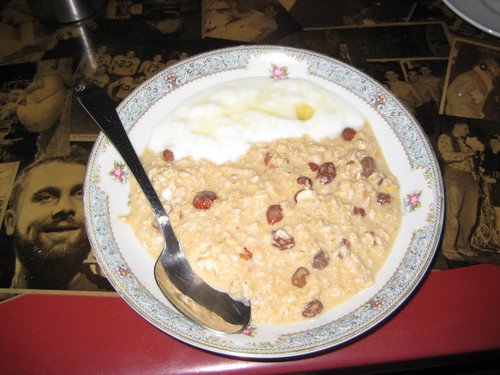
My wife found a delicious recipe for meusli, a euro-type breakfast, in a cookbook you may not know about. Feeding the Whole Family: Cooking with Whole Foods, by Cynthia Lair, is a very accessible collection of recipes emphasizing simple meals with healthful, seasonal ingredients (parents may remember Cynthia as a food writer/editor for Mothering Magazine). Don't confuse muesli with Mueslix, the dorky brand of Kellogg's cereal from the 80s. Real muesli is a simple breakfast of rolled oats (or other grains) and any combination of nuts and dried/fresh fruit. It's basically granola that hasn't been toasted. There are two styles: dry and soaked. In the dry version, muesli is eaten as is, with milk or yogurt. In the soaked version, the muesli is first allowed to sit in hot water or juice for a few hours or even overnight. Both are delicious, but we were intrigued by the soaked version as it produces a filling breakfast that can stand in for oatmeal in the summer. Despite the use of boiling water in the recipe below, the texture of soaked muesli is not the same as oatmeal. Give it a try this summer. It will keep your mornings sane and your kitchen cool.

Orange Hazelnut Muesli

Prep time: 10 minutes (excluding overnight soaking)

Ingredients

  • 2 cups rolled oats or rolled barley (or some of both)
  • 1/3 cup hazelnuts, chopped
  • 1/3 cup raisins
  • 1/2 teaspoon ground cinnamon
  • 1/2 teaspoon sea salt
  • 2 cups boiling water
  • 1 cup freshly squeezed orange juice
  • Optional toppings: sliced fruit, berries, raisins, plain yogurt w/ honey
Technique

Place oats, hazelnuts, raisins, cinnamon, and sea salt in mixing bowl. Pour boiling water over mixture and stir. Add orange juice to mixture and stir again. Cover bowl with plate or cloth and allow moisture to soften grains 6 to 8 hours or overnight. Top apple, pear, berries, and/or yogurt.

*Makes 4 servings


Wednesday, June 24, 2009

a few thoughts on the cookie dough recall

It is a national story, but I read about the recent Nestle cookie dough recall as a local article in the St. Paul Pioneer Press. Six Minnesotans, between 2 and 18 years of age, became quite ill from eating raw dough. This is disturbing on many levels, and it seems food recalls are simply part of "what happens." Is anyone outraged? At some point people do eat at their own risk, but as a society we can surely do more to prevent the spread of tainted food. I imagine that warnings printed on labels often do little to prevent people from eating certain foods raw, and despite manufacturers' and public health officials' official concerns, people enjoy eating cookie dough. They also enjoy runny eggs, rare steaks, and bloody hamburgers. Even steak tartare has enjoyed a renaissance as of late. If sourced and handled appropriately, many allegedly dangerous foods can be safely enjoyed in a raw or lightly cooked state. Mass-produced, industrial tubs of dough do not belong on this list, but their existence influences how people, including public officials, view the honest, homemade variety.

It begs the question: how could there be such a huge market for manufactured cookie dough? Please tell me. The concept is absurd, but an insipidly clever marketing idea. Busy people, who apparently don't have enough time to measure more than four ingredients, can purchase this dough-like substance, press or cut it into shapes, and convince themselves that they are, in fact, baking. It's akin to serving microwave bacon. I have tears in my eyes.

Real cookie dough is a wonderful thing. The alchemical marriage of flour, butter, sugar, and chocolate chips is truly potent, an ethereal mix to be honored in its own right. Freshly baked chocolate chip cookies are wantonly desired by children and adults across this great country, and they are one of the few truly notable American foodstuffs. We don't have many. Must we desecrate them through food engineering and negligent mass production?

We have all heard the warnings. Do not eat raw eggs. Do not eat cookie dough, because it contains raw eggs. When was the last time you heard of someone dying from a raw egg that contained e. coli bacteria? I encourage you to read the Wikipedia entry for this bacterium, as it appears poop is the typical culprit. Yes, poop. Salmonella is most often the bacterium associated with raw eggs, so it is unclear how e. coli made its way into Nestle's cookie dough, but we could take a wild guess. Public health experts and Nestlé officials: please post a comment. I also recommend reading this article from the Today Show, which describes how e. coli is most often found in raw meat or unwashed fruits and vegetables.

What bothers me the most is the MN Dept of Public Health's first quote in the aforementioned article:

Health officials warned that eating any kind of raw dough creates potential for illness. "Cookie dough, whether purchased in a tub from the store or made at home from scratch, should not be eaten raw," said Carlota Medus, a foodborne-illness epidemiologist with the Minnesota Department of Health.


Rather than push Nestle to explain how such contaminants could enter their supply chain, our public servants simply cover Nestle's ass by implying that consumers may have brought this upon themselves by eating raw cookie dough. What a joke. If you care to make your own cookie dough, from the best ingredients you can find (organic butter, organic sugar, organic eggs, and chocolate chips), and store them properly, it seems the risk of contamination
is very low, perhaps even nonexistent. Maybe I'm missing something here, but my family regularly eats sunny-side-up eggs, and spoonfulls of raw cookie dough. We have never been ill. My pregnant wife eats these things.

The warnings exist to cover the lowest common denominator, the lowest quality (but cheapest!) ingredients one could possibly procure from a discount, big box grocer. But even then it's probably a low risk. Only when our dough is manufactured on a massive scale, by assembly line workers with bad habits, is there such a risk. If your grandma doesn't wash her hands, your family may get ill. If the "dough mixing technician" at the Nestle plant doesn't wash his hands, an entire city may puke its guts out, literally.

I'll leave you with the list of ingredients for one of the recalled products: "Ultimates Peanut Butter Cups, Chips & Chocolate Chunks bar." I've highlighted the nasty/processed/synthetic ingredients in red, if e. coli isn't enought to stop you. Bon appetit!


INGREDIENTS: BLEACHED ENRICHED FLOUR (WHEAT FLOUR, NIACIN, REDUCED IRON, THIAMIN MONONITRATE, RIBOFLAVIN, FOLIC ACID), SUGAR, MARGARINE (PALM OIL, WATER, SUNFLOWER OIL, HYDROGENATED COTTONSEED OIL, SALT, VEGETABLE MONO- AND DIGLYCERIDES, SOY LECITHIN, SODIUM BENZOATE, CITRIC ACID, NATURAL AND ARTIFICIAL FLAVOR, BETA CAROTENE COLOR, VITAMIN A PALMITATE ADDED), NESTLE SEMI-SWEET CHOCOLATE CHUNKS (SEMI-SWEET CHOCOLATE [SUGAR, CHOCOLATE, COCOA BUTTER, MILKFAT, SOY LECITHIN, VANILLIN - AN ARTIFICIAL FLAVOR, NATURAL FLAV0R]), PEANUT BUTTER FLAVORED MORSELS (SUGAR, PALM KERNEL OIL, PEANUTS, PEANUT FLOUR, LACTOSE, WHEY [FROM MILK], MILKFAT, NONFAT MILK, SODIUM CASEINATE [FROM MILK], BUTTERMILK, HYDROGENATED PALM OIL, SALT, SOY LECITHIN, ARTIFICIAL FLAVORS), PEANUT BUTTER CUPS (SUGAR, PALM KERNEL OIL, PEANUT FLOUR, NONFAT MILK, PEANUT BUTTER [PEANUTS, SALT, PARTIALLY HYDROGENATED PALM OIL], PARTIALLY HYDROGENATED PALM OIL, SALT, COCONUT OIL, COLOR ADDED [RED 40 LAKE, YELLOW 5 LAKE AND BLUE 2 LAKE], SOY LECITHIN, TBHQ, CITRIC ACID), WATER, CORN SYRUP SOLIDS, MOLASSES, EGGS, EGG YOLKS, BAKING SODA, SALT, SODIUM ALUMINUM PHOSPHATE, VANILLA EXTRACT, VANILLIN - AN ARTIFICIAL FLAVOR

P.S. The voluntary recall includes 43 varieties of cookie dough sold by Nestle. You can access nutritional information about each of them at Nestle's wonderful cookie dough site: http://www.verybestbaking.com/. Don't event get me started on the ridiculousness of that name. Very best indeed.

Thursday, June 18, 2009

the humble frittata

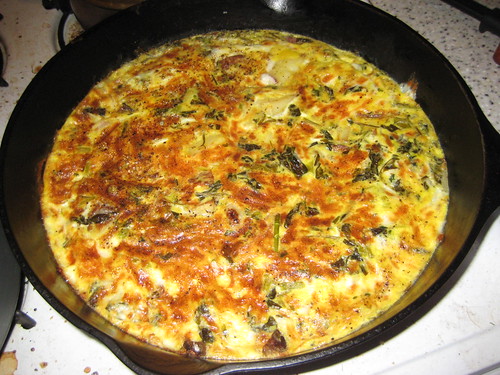
Peasant cooking at it's best, many cookbook authors and magazine writers have touted the simplicity of this Italian staple. Nearly identical to the Spanish tortilla, the frittata is the ideal vehicle to dispose of leftover vegetables and other items languishing in your fridge. It is also an ideal summer meal, as it requires just a few minutes in the broiler and tastes great the following day, even served cool or at room temperature. Many variations exist, but core elements include sauteed vegetables, cheese and/or cream, and at least six eggs. The recipe below is a hybrid of several recipes that is easy to prepare and works well for me. I've listed some suggested ingredients but this dish is so flexible that I strongly encourage using nearly any ingredient that would taste good with eggs. Bacon is quite tasty, as well as leftover roast turkey or chicken.

Ingredients

  • 6-8 eggs, depending on the size of your skillet and appetite
  • 1/2 cup milk or cream
  • 1/2 onion
  • 1/2 lb mushrooms, quartered (or other vegetables)
  • 2 tablespoons minced fresh herbs (parsley, basil, or thyme)
  • 1 cup grated cheese (parmesan, mozzarella, or chevre work well)
  • 4 tablespoons olive oil
  • kosher salt and coarsely ground pepper
Equipment
  • large, well seasoned cast iron or stainless steel skillet (you could use nonstick but I don't recommend it because of new research regarding toxins) - make sure the skillet has a metal handle, as it will go in the broiler
  • oven with a broiler
Technique
  1. Preheat your broiler. Heat two tablespoons of oil in the skillet over medium-high heat. When oil is nearly smoking, add the onions and mushrooms. Sauté them until the mushrooms have released their juices and the liquid has evaporated from the pan (10-15 minutes).
  2. In a large bowl, combine eggs, cream/milk, and herbs. Beat vigorously with a whisk or fork for several minutes (this will make the frittata fluffy).
  3. Lower the heat to low, stir in remaining olive oil, and pour the egg mixture in the skillet. Lightly stir eggs to incorporate sautéed vegetables.
  4. Once the eggs at the bottom have started to firm up, add the cheese and fold it into the egg mixture that is still liquid.
  5. Put the skillet in the broiler and cook for 3-6 minutes or until the top is lightly browned and the eggs are no longer runny (but do not overcook).
  6. Remove from broiler, sprinkle with salt and pepper, and slice into wedges.
  7. Drizzle with additional olive oil if desired.
*Serves 4 as a main event or 6 as a first course