Wednesday, February 18, 2009

saucisson update: fully cured and edible! (sort of)


At long last, I decided to eat one of my saucissons. In my last update I decided to let them cure a bit longer to make sure the interior of the sausage was fully cured. The big day was last Wednesday - I've been so busy with work and a toddler daughter that I haven't been able to post about it yet.

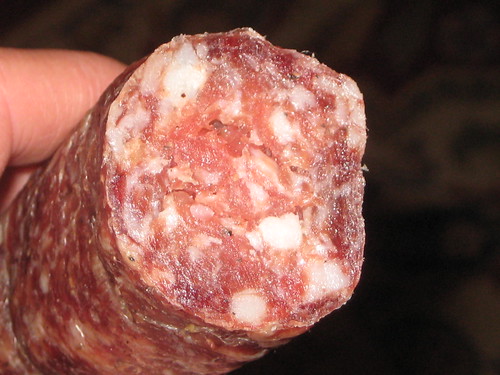
The good news is that the saucissons are fully cured (no raw meat in the middle), but as feared, I think the outside cured too fast given the low humidity level in my basement during the month of January. The resulting saucisson is edible, as I ate several pieces and did not puke or die, but the interior does have a slightly brownish tint which indicates that the exterior dried too fast (this is visible in the photo above). I don't think the interior rotted, because it doesn't smell bad, but I do think it wasn't able to dry evenly because the exterior cured too fast. As a result the saucisson has an off taste which isn't exactly delicious.

Rest assured, I will purchase a humidifier and give it another try. In Minnesota humidity levels are higher in the spring, which should also help. We shall overcome.

Saturday, January 31, 2009

great article in Star Tribune about local food trends

In case you missed it, earlier this month the Star Tribune's Nancy Ngo published a great article on food trends for 2009. Among other more trivial bits, such as speculation about Peru becoming the next hip food culture for Americans, the article does highlight some key trends related to home cooking and eating sustainably.

For several authorities, it's a deliberate, unapologetic return to home cooking. In its January issue, Food & Wine magazine names home cooking as the biggest food trend of the year, with an emphasis on retooled comfort food classics, entertaining on a budget and "exotic" recipes made easy.

The National Restaurant Association calls it philosophy-driven choices, this continuing trend toward "green" eating in its many permutations. And the chefs expect to see much more of it. In fact, local produce ranked No. 1 in the What's Hot survey. Nine in 10 chefs said demand for locally grown menu items would increase, along with demand for sustainable seafood, organic produce and free-range meats.


Friday, January 30, 2009

saucisson update: going to wait a few more days

I went down to the cellar last night to check on the salumi and I think they still need some more time. We're well past the three week mark, but when I squeeze them there's still a little too much resistance on the thicker parts. I'll check again on Sunday - be prepared.

Wednesday, January 28, 2009

cabbage soup deserves more respect

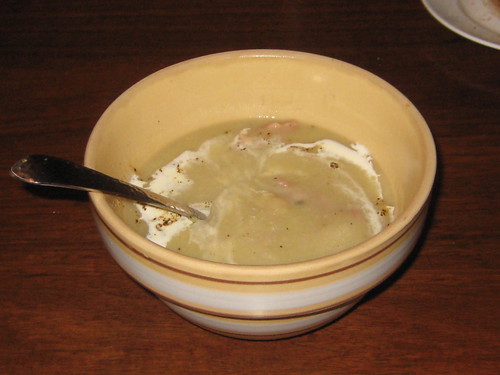
When was the last time you ate a bowl of cabbage soup that wasn't borscht? Let's face it: green cabbage isn't sexy. Radicchio is cool because it's small and pretty, and you don't have to say the word cabbage when discussing it. Napa cabbage is a touch more sophisticated because it reminds one of verdant green valleys of vineyards. But ubiquitous green cabbage, my friends, often evokes images of damp medieval huts and grubby serfs, or the funky humid smell that often accompanies over-cooked, mushy renditions of cabbage that misrepresent the beauty and utility of this particular vegetable.

Cabbage soup, in particular, can be extra stinky, so it is often avoided to prevent its unique odors from permeating your house, children, and belongings.

Forget what you just read and try the soup recipe below. It smells great and demonstrates the many reasons one should respect and cherish the simplicity of green/white cabbage, such as:

  1. It tastes great when prepared properly, whether cooked as soup, braised as a side dish, shredded for a salad (think coleslaw), or cured as sauerkraut;
  2. Cabbage is perhaps one of the cheapest vegetables available (often selling for 99 cents per pound or less!);
  3. It stores very well in the refrigerator - I harvested the cabbage for the soup in the picture from my garden in early November and didn't eat them until January - they were simply wrapped in plastic in my crisper);
  4. Cabbage is one of the few local vegetables that is available midwinter in Minnesota and other northern states.
This recipe serves 6 as first course or 4 as a main dish.

ingredients

  • 1/2 cup olive oil
  • 1 large green or white cabbage, cored and sliced very thin
  • 3/4 cup white wine
  • 3 large potatoes, coarsely chopped
  • 2 onions, coarsely chopped
  • a pinch of freshly grated nutmeg
  • 6 thick slices of fresh pork belly (or 1 cup cubed bacon or ham)
  • 3 garlic cloves, thinly sliced
  • 1 cup heavy cream
  • salt and pepper
technique
  1. Heat 5 tablespoons of the oil in a heavy dutch oven or soup pot. Add the cabbage and cook, stirring occasionally, for a few minutes, until softened but not colored. Add the white wine, potatoes, onions, and nutmeg and pour in enough water to cover. Add the pork and bring to a boil, then lower the heat, and simmer gently for about 1 hour, until the meat is tender.
  2. Remove the meat with a slotted spoon. Transfer the soup to a blender or food processor and process until smooth. Season to taste with salt and pepper.
  3. Heat the remaining oil in a small skillet. Add the garlic and cook over low heat, stirring frequently, unti it is just beginning to color. If necessary, reheat the soup over low heat to keep hot.
  4. Serve hot in bowls with a swirl of cream and the garlic chips. If using pork belly, place one piece in each bowl or upon a piece of toasted bread. If using ham or bacon, divide evenly among each bowl.
This is a very hearty soup that easily works as dinner with some good bread and a big beer or glass of dry white wine.

Note: I adapted this recipe from Pork & Sons, which I wrote about earlier this week.

Sunday, January 25, 2009

Pork & Sons: a superb cookbook and tribute to the noble pig

For Christmas my wife granted me a copy of Pork & Sons by Stephane Reynaud, a third generation "pork devotee" and butcher/charcutier. If you haven't heard about this book, it is a whimsical French cookbook that also documents the fascinating world of artisanal hog farming, butchering, and charcuterie in France through words and photography. First published in French in 2005, it has been available in English since 2007.

Aside from containing some truly authentic recipes for rural French food (each of which contains pork in some form, of course), this book reinforces the notion that eating meat in an ethical, sustainable fashion does, in fact, assert and celebrate the inherent dignity of animals raised for food. It also exposes, in a succinct and beatiful fashion, the quiet reverence French farmers, butchers, and charcutiers have for the animals they raise, process, and eat. Something most Americans have either forgotten or never known.

"It is fortunate that the standardization of flavor in today's food industry has not yet reached the Ardeche region, where tradition mounts a good defense."

So far I have only cooked one recipe from the book, a delicious take on cabbage soup, but I am anxious to try many more. I'll post the cabbage soup recipe this week, as further proof that you should own this book.

saucisson update: nearly cured!

Just a brief post to let you know that I checked on my saucissons last night and I believe the smallest of the three is nearly cured, with the others shortly behind. As I wrote on Wednesday, the inside of the saucisson was still raw when I sliced one of them (they also felt a little squishy when squeezed). It is still way too friggin' cold and dry, which has kept my basement humidity levels way below the optimum 60-70% range, but it appears the saucissons are drying all the way through without rotting. Tomorrow represents the 21st day of curing, which falls within the timeline recommended by Brian Polcyn and Michael Ruhlman, so I'm planning to perform a slice test midweek - just to be safe...

Thursday, January 22, 2009

saucisson update: on the operating table

I just could not wait any longer. As I wrote on Sunday, the saucissons reached the 35% mark for overall weight loss. This was good and bad news, as it means they might be dry enough to eat, but they also reached that weight in only 14 days (rather than 18-21 per the traditional curing instructions). I have four saucissons hanging, so I decided to slice one to determine their dryness and edibility. They were a little squishy when I squeezed them, which indicated that they may still be a little raw on the interior, but there's only one way to find out. Upon slicing the end off one of them, it was clear that the interior was a little raw. It's very subtle, but in the photograph you can see a slight color variation between the outer third (crimson) and the inside (orange). The good news is that it doesn't appear to be spoiled - it smells like salami.

I hung this one back up to dry for another week. Stay tuned...